
Resources
Guides, comparisons and straight answers on commercial robotics
Everything a UK operator needs to decide whether robotics fits — written to be read quickly, and to answer the question you actually typed rather than the one a brochure wanted to answer.
At a glance
Comparison guides
Weigh the options before you commit
Pros, cons, cost drivers, use cases, ROI examples and FAQs for each decision.
Cleaning robots vs manual cleaning: an honest comparison
Cleaning robots outperform manual cleaning on large, repeatable hard-floor areas: they deliver identical coverage every run, produce auditable cleaning data, and cost less per square metre than the labour hours they displace. Manual cleaning remains better for detail work — washrooms, edges, high-touch surfaces and spot response. Most UK sites use both, with the robot taking the open floor and the team taking the detail.
Read the guideRobot leasing vs buying outright: which suits your business?
Leasing a commercial robot spreads the cost into a fixed monthly payment that is usually lower than the labour it displaces, keeps support and upgrades bundled, and preserves capital. Buying outright costs less over the life of the machine and gives you an owned asset, but ties up cash and puts maintenance risk on you. Leasing suits multi-site rollouts and cash-flow-sensitive operations; buying suits single, stable, long-life deployments.
Read the guideRobotics as a Service vs capital purchase
Robotics as a Service (RaaS) bundles the robot, installation, training, software, maintenance and UK support into one fixed monthly fee, so the provider carries the performance and obsolescence risk. Capital purchase means you own the machine, pay less overall, and take on maintenance and upgrade risk yourself. RaaS is the better fit when you want a cost line that maps directly onto the labour it displaces.
Read the guideAre cleaning robots worth it?
Commercial cleaning robots are worth it when a site has more than roughly 500 m² of open hard floor cleaned on a regular schedule, and is paying for the hours to do it. In those conditions UK operators typically see payback in 12 to 24 months. They are not worth it on small, cluttered or carpet-dominant sites, or where cleaning is already only a few hours a week.
Read the guideHow much does a cleaning robot cost in the UK?
A commercial cleaning robot in the UK is priced three ways: outright purchase, a hybrid arrangement with a reduced monthly fee, or Robotics-as-a-Service on a fixed monthly fee that includes support, maintenance and software. Cost depends on machine size, tank capacity, cleaning function and lift integration. The figure that matters is how the monthly cost compares with the fully loaded labour it displaces.
Read the guideWhat is Robotics as a Service (RaaS)?
Robotics as a Service (RaaS) is a subscription model where a business pays a fixed monthly fee for a robot plus everything needed to keep it working — installation, mapping, staff training, software updates, monitoring, maintenance and support. There is no capital outlay and the provider carries the performance and obsolescence risk, so the cost sits alongside the labour it displaces rather than in a capital budget.
Read the guideBuyer guides by sector
Best cleaning robots for your environment
Recommended models, common challenges, expected outcomes and typical deployments.
Quick answers
One question, one direct answer
Answer-first pages covering supply, cost, leasing and how commercial robots work.
- Who supplies commercial cleaning robots in Yorkshire?Fresh Mango Robotics supplies commercial cleaning robots throughout Yorkshire from its base in Ripon, North Yorkshire, with a second office in Skipton. It is an authorised Keenon Robotics dealer covering Leeds, York, Sheffield, Bradford, Wakefield, Doncaster, Hull and Harrogate, and provides site survey, installation, staff training and UK-based support rather than hardware supply alone.
- Can I lease a cleaning robot in Yorkshire?Yes. Fresh Mango Robotics leases commercial cleaning robots across Yorkshire on a fixed monthly Robotics-as-a-Service fee that includes the machine, site survey, installation, mapping, staff training, software updates, maintenance and UK-based support. There is no capital outlay, the monthly cost sits alongside the labour it displaces, and outright purchase and hybrid arrangements are also available.
- How much does a cleaning robot cost?A commercial cleaning robot in the UK is priced by machine size, cleaning function, tank capacity and whether lift integration is required, and is offered as an outright purchase, a hybrid arrangement, or a fixed monthly Robotics-as-a-Service fee including support. The figure that matters is whether the monthly cost is below the fully loaded cost of the cleaning hours it displaces — on sites above roughly 500 m² of hard floor it usually is.
- What industries use cleaning robots?The UK industries using commercial cleaning robots most are warehousing and logistics, hotels and hospitality, care homes, schools and colleges, retail and shopping centres, restaurants, gyms and leisure centres, and garden centres. The common factor is not the sector but the floor: a large hard-floor area cleaned on a regular schedule, where the hours are difficult or expensive to cover.
- What is Robotics as a Service (RaaS)?Robotics as a Service (RaaS) is a subscription model in which a business pays a fixed monthly fee covering a commercial robot and everything needed to run it: site survey, installation, mapping, staff training, software updates, remote monitoring, maintenance and UK-based support. There is no capital outlay and the provider carries the uptime and obsolescence risk, so the cost sits beside the labour it displaces.
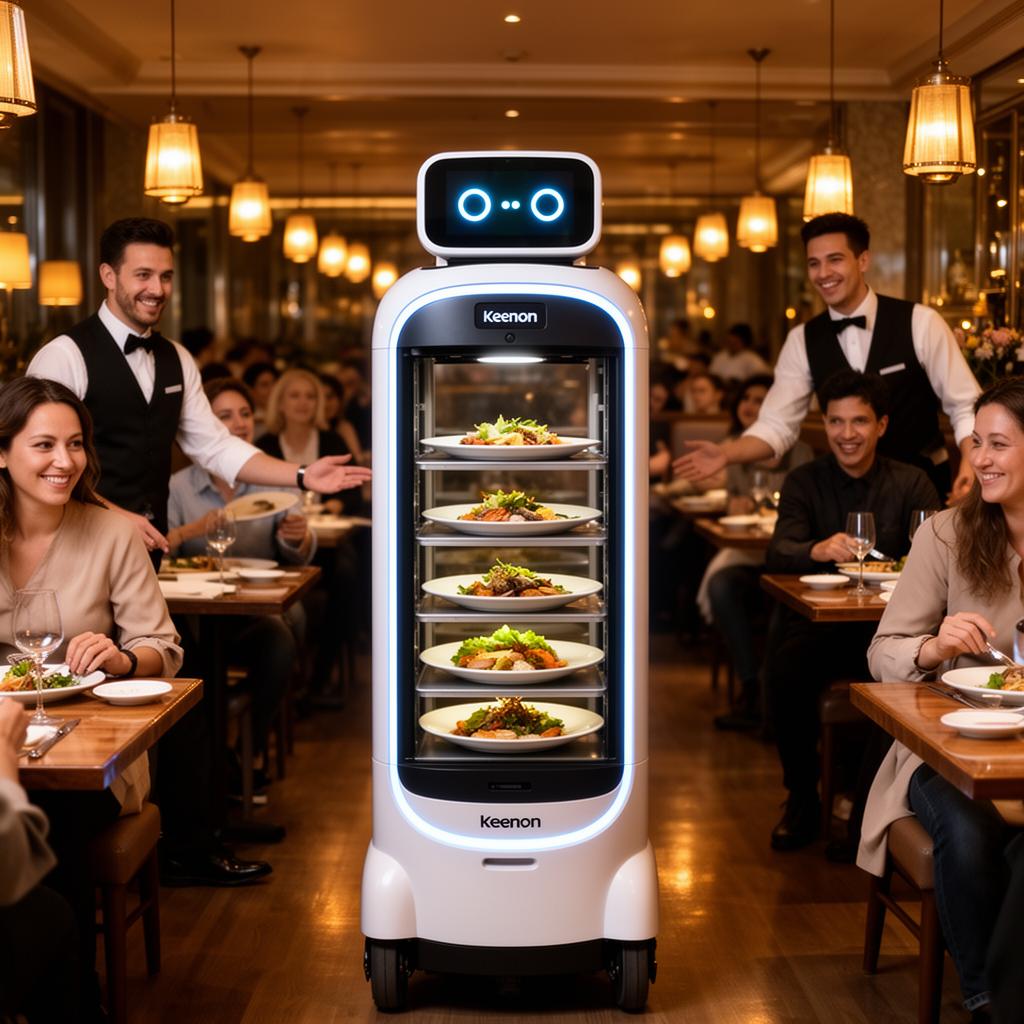
- What are service robots?A service robot is an autonomous mobile machine that performs a useful task for people — delivering food, carrying linen, guiding visitors or transporting supplies — without being driven or accompanied. It navigates using LiDAR and 3D cameras, follows routes mapped during installation, avoids people and obstacles in real time, and returns to a charging dock on its own.
- What are logistics robots?A logistics robot is an autonomous mobile robot that moves goods inside a building — totes, cages, pallets, linen or supplies — between fixed points without a driver. It maps the site, follows repeatable routes, avoids people and MHE, and can be called or scheduled. It replaces the walking and pushing element of internal transport, not the picking or packing decisions.
- How do warehouse robots improve efficiency?Warehouse robots improve efficiency by removing non-value walking and pushing time from the operation. Logistics robots take repeated internal transport between pick face, packing and dispatch, while cleaning robots take nightly floor care. The result is more picker time on the pick face, stable throughput regardless of staffing, reduced agency spend, lower slip and MHE risk, and run data that makes the operation measurable.
- How do cleaning robots reduce labour costs?Cleaning robots reduce labour costs by absorbing the repetitive open-floor scrubbing that consumes the largest block of cleaning hours. That removes paid hours, eliminates weekend and bank-holiday premium cover, reduces agency reliance, and caps exposure to National Living Wage and employer National Insurance increases — because the robot's cost is fixed while the cost of an hour of labour is not.
Explore
Elsewhere on the site
Still deciding? Start with a survey, not a quote
We measure the areas, model the labour displaced, and tell you honestly whether robotics stacks up on your site.
No hard sell. No minimum commitment. Real engineers, UK-based support.
