
What are service robots?
Direct answer
Key facts
- Autonomous: no operator, no track, no guide wire.
- Navigates with LiDAR and 3D vision, mapped to your building.
- Main UK types: food running, guest delivery, guidance, logistics transport.
- Safe around people — designed for occupied public environments.
- Self-docking and self-charging between runs.
- Common in hotels, restaurants, care homes, hospitals and retail.
The main categories in UK use
Service robotics is a broad term. In UK commercial deployments it breaks down into four practical groups.
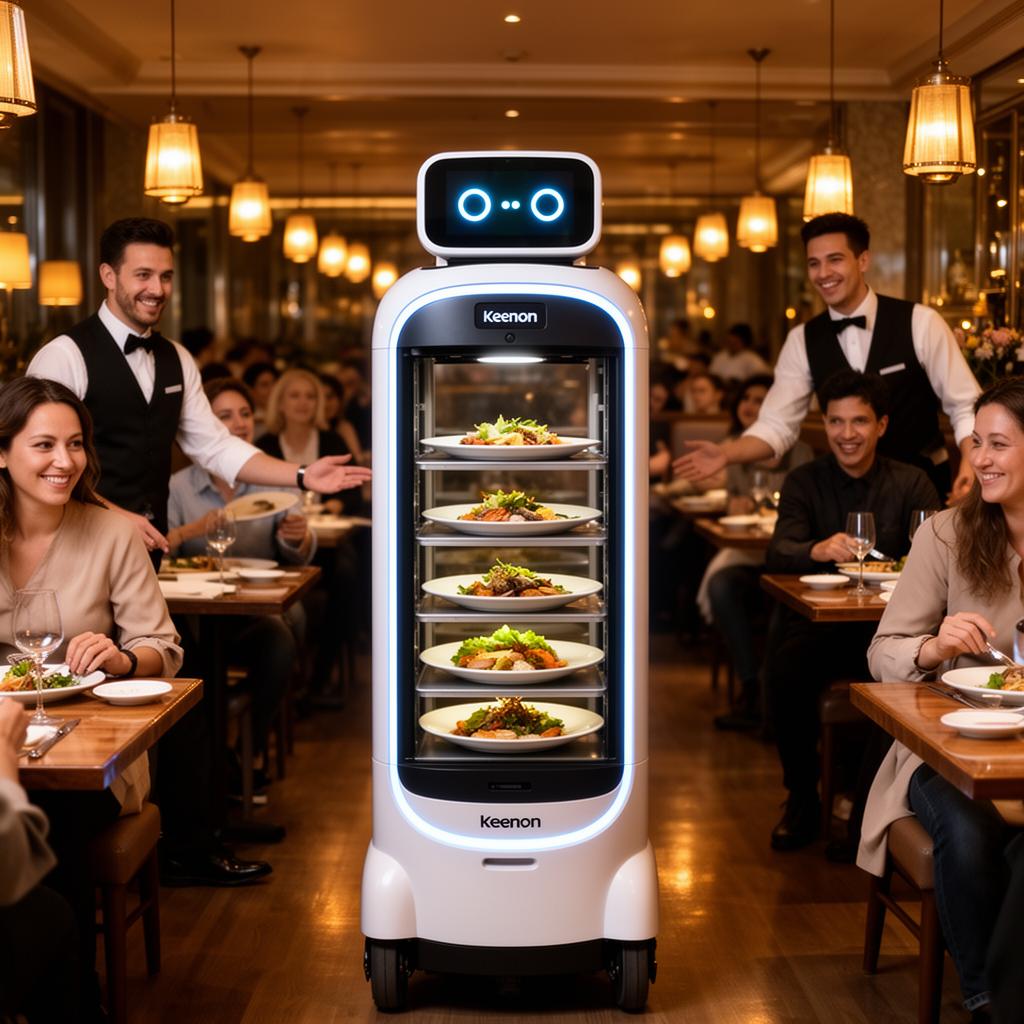
- Food and drink running — DINERBOT models carrying multiple trays between kitchen and table
- Guest and resident delivery — BUTLERBOT W3 with lift integration for amenities, linen and meals
- Guidance and reception — greeting, wayfinding and promotional display
- Internal logistics — S100 and S300 moving totes, cages and supplies
What a service robot actually changes
The measurable change is walking distance. In a restaurant, servers spend a large share of a shift carrying plates in a straight line; in a care home, staff spend it pushing trolleys along corridors.
Handing that predictable transport to a machine returns those minutes to the work that needs a person — taking an order, checking on a resident, resolving a complaint.
Related questions
What is a service robot?
An autonomous mobile machine that carries out a practical task for people — food running, delivery, guidance or internal transport — without being driven. It navigates using LiDAR and 3D cameras, follows mapped routes, avoids people and obstacles, and charges itself.
How do service robots navigate a building?
During installation the building is mapped and routes, docking points and no-go zones are configured. In use the robot combines that map with live LiDAR and 3D camera data to position itself and route around people and obstacles.
Are service robots safe around customers and residents?
Yes. They are designed for occupied public environments, detect people and obstacles, slow down in busy areas and stop rather than push through. They are routinely used in hotels, restaurants and care homes.
What is the difference between a service robot and a cleaning robot?
A cleaning robot performs floor care; a service robot transports things or interacts with people. Both are autonomous mobile robots using the same underlying navigation, and many sites run both.
Keep reading
Other answers
Want this answered for your site specifically?
We survey the building, measure the addressable area and give you the numbers for your operation — not an average.
No hard sell. No minimum commitment. Real engineers, UK-based support.