
Beyond Humanoid Hype: Where Service Robots Actually Earn Their Keep in 2026
Humanoids attract attention, but the robots that earn their keep are the ones matched to a real task. A practical guide to choosing the job before the robot.
Quick answer
A commercial service robot is an autonomous or semi-autonomous machine that performs a practical task in a business environment. Choose by task, not appearance: an XMAN humanoid for greeting and wayfinding, a DINERBOT for restaurant delivery, a BUTLERBOT W3 for room service, a KLEENBOT for floor cleaning, a KEENON S100 for internal transport and an XBOT for automated coffee.
The robot that looks most impressive is not always the right one
Humanoid robots attract attention because they look familiar, move around people and can interact directly with visitors. That makes them useful in some commercial environments.
However, most organisations are not trying to create a robotics demonstration. They are trying to solve a specific operational problem:
- Moving meals from a kitchen to a table
- Delivering room service across several hotel floors
- Scrubbing large areas of hard flooring
- Transporting stock around a warehouse
- Providing coffee in a location without a staffed barista counter
- Greeting and guiding customers in a busy public space
The practical question is not, "Which robot looks most advanced?" It is:
"Which robot is best suited to the task, the site and the team that will use it?"
Fresh Mango Robotics supplies the full range of commercial service robots, from the KEENON XMAN-R1 humanoid robot to specialist delivery, cleaning, logistics and coffee machines.
What is a commercial service robot?
A commercial service robot is an autonomous or semi-autonomous machine designed to perform a practical task in a business environment.
Unlike factory robots fixed to a production line, service robots typically work in shared spaces such as:
- Restaurants and hotels
- Hospitals and care homes
- Retail stores and shopping centres
- Warehouses and distribution centres
- Offices, campuses and transport hubs
They use sensors, mapping and software to navigate their environment. Some carry goods, some clean floors, some prepare drinks and others interact with customers.
The best deployment is usually one that removes a repetitive, tiring or predictable task while allowing employees to focus on customer care, judgement and specialist work.
Which service robot suits which task?
| Task type | Best-suited robot category | Why it fits |
|---|---|---|
| Greeting, wayfinding and routine customer interaction | XMAN humanoid robot | Designed for face-to-face interaction and mobility in spaces built for people |
| Food and drink delivery in restaurants | DINERBOT T9, T10 or T11 | Purpose-built for moving multiple trays from the kitchen to tables |
| Hotel room service and amenity delivery | BUTLERBOT W3 | Designed for corridors, lifts and secure room delivery |
| Large-area floor cleaning | KLEENBOT C30 or C40 | Built for repeatable commercial floor-cleaning routes |
| Internal warehouse transport | KEENON S100 | Designed to move loads between fixed points while staff remain on higher-value work |
| Automated coffee service | XBOT S PRO | Provides a consistent coffee offer in hotels, offices, campuses and transport hubs |
| Heavy or repetitive manual handling | Warehouse logistics robots | More suitable than a humanoid for carrying loads repeatedly and efficiently |
This is why a task-specific robot is often the simpler choice. It has been designed around one job and can be assessed against clear operational measures.
Where the Fresh Mango Robotics portfolio fits
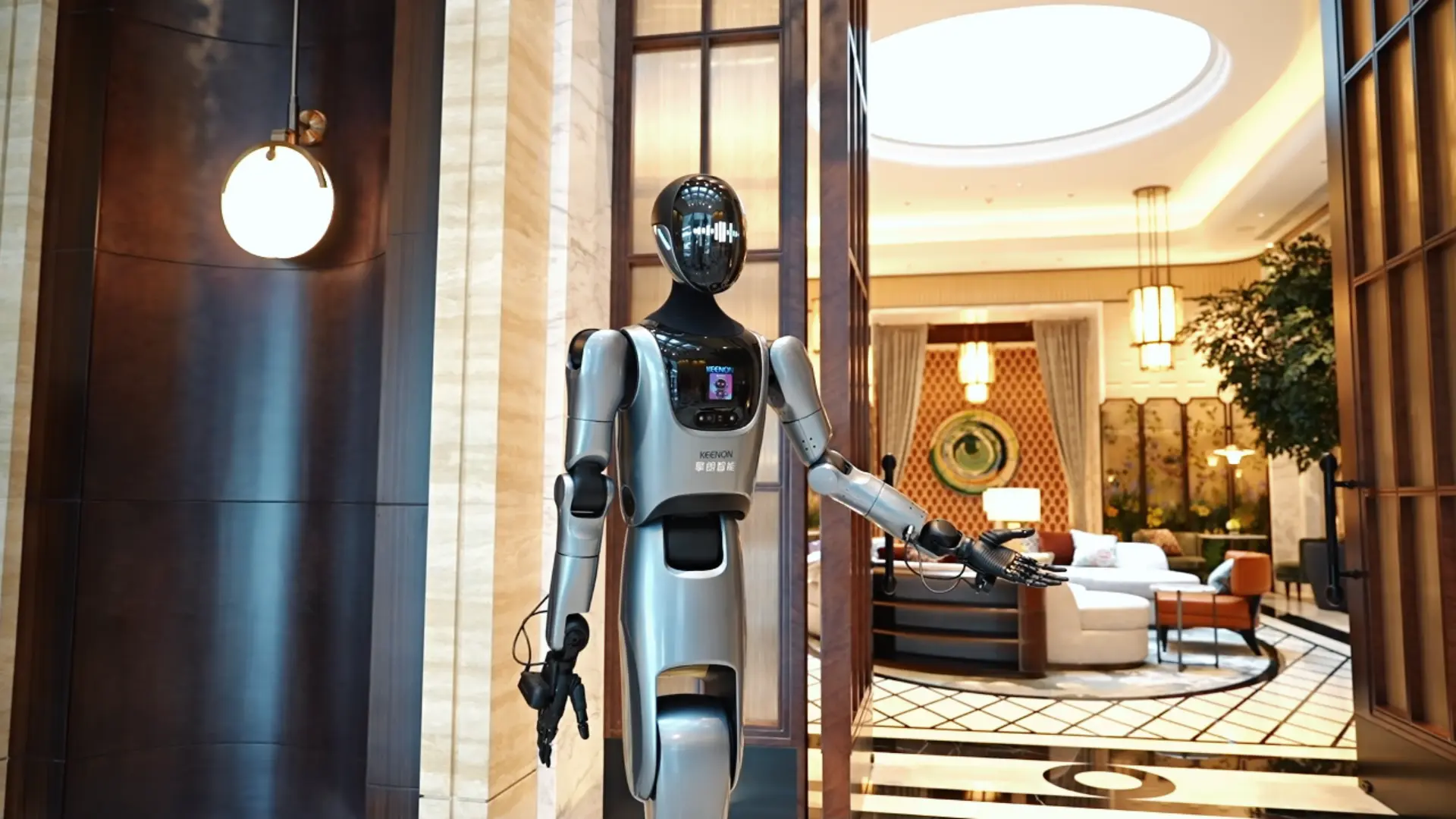
XMAN humanoid robots: interaction, presence and mobility
The KEENON XMAN-R1 humanoid service robot is designed for customer-facing environments. It can support:
- Greeting visitors
- Answering routine questions
- Providing information on a screen
- Guiding or escorting people
- Supporting light item handovers
- Creating a visible point of interaction in a reception or public area
Its human-scale form is useful where visitors need to approach, speak to and follow a robot. This may include hotel lobbies, retail environments, healthcare receptions, events, corporate buildings and visitor attractions.
The XMAN is not the best choice for every physical task. It is not a replacement for a high-capacity delivery robot, an autonomous floor scrubber or a warehouse load mover. If the requirement is to carry trays continuously or move heavy stock, a specialist machine is likely to be easier to deploy and justify.
The honest commercial case for an XMAN humanoid robot is customer interaction and presence. It gives a business a mobile, conversational point of contact in an environment designed for people.
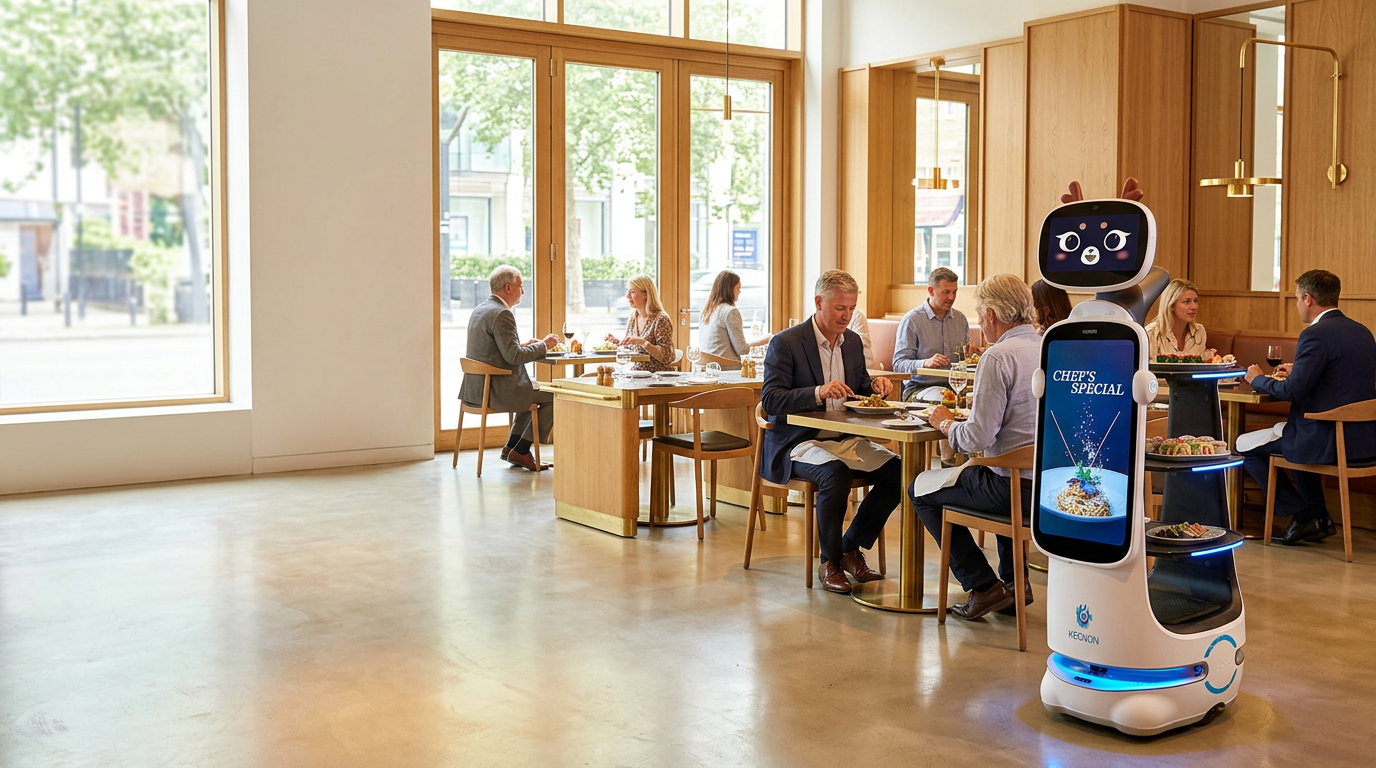
Restaurant delivery robots: DINERBOT T9, T10 and T11
DINERBOT restaurant delivery robots are designed to move food, drinks and cleared items around a dining area.
The DINERBOT T9, T10 and T11 are suited to larger restaurants, banqueting operations, hotels and venues where staff spend significant time walking between the kitchen and tables.
They do not take orders, resolve complaints or replace hospitality. Their role is more straightforward: reduce the number of repetitive carrying journeys. That allows team members to spend more time:
- Welcoming guests
- Explaining menus
- Handling dietary questions
- Checking satisfaction
- Managing service recovery
For service robots for restaurants, the clearest business case is usually a busy, repeatable route between a pass, bar or kitchen and the dining floor.
BUTLERBOT W3: hotel and care delivery
The BUTLERBOT W3 is designed for hotel room service, amenity delivery and similar internal transport tasks. It is suited to properties where employees regularly move:
- Meals and drinks
- Towels and toiletries
- Guest amenities
- Linen
- Small supplies
The W3 is particularly relevant to hotels, serviced apartments, clinics and care environments. It can work with lifts and mapped corridors, subject to a site survey and integration requirements.
The robot does not replace the personal element of room service. Staff still prepare the order, respond to guest requests and manage exceptions. The robot handles the journey through the building.
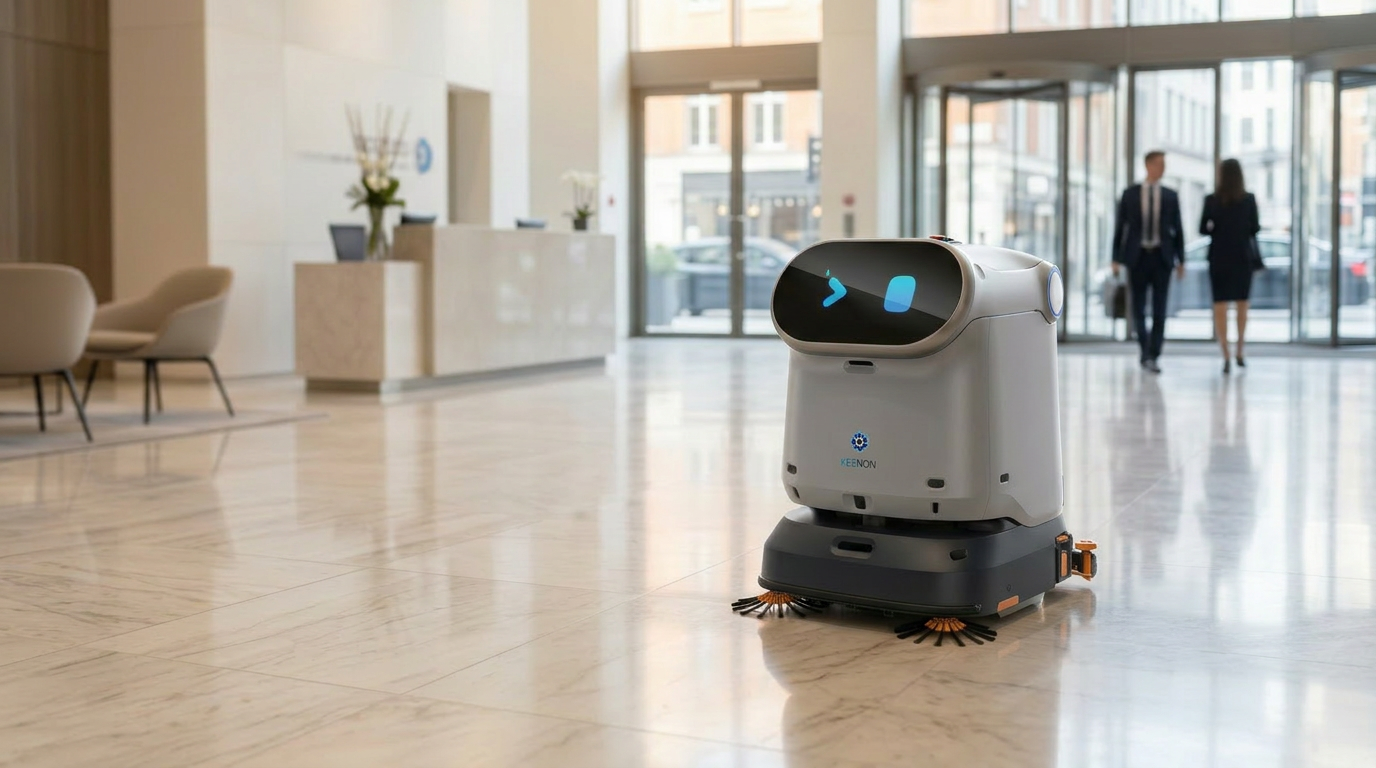
KLEENBOT C30 and C40: autonomous floor cleaning
Cleaning is one of the strongest applications for commercial robotics because many buildings contain large, hard-floor areas with predictable routes.
The KLEENBOT C30 and KLEENBOT C40 are designed for autonomous floor-cleaning work in environments such as retail, healthcare, hospitality, transport and logistics. They can support routine sweeping, scrubbing, vacuuming and drying, depending on the model and configuration.
An autonomous floor scrubber is not a complete replacement for a cleaning team. Staff are still required for corners, stairs, washrooms, spill response, detail work and hygiene checks. The value is in taking over repeatable coverage across larger open floors.
This is also where industrial floor cleaning robots can help facilities teams maintain a more consistent cleaning routine without asking employees to spend every shift pushing equipment across large areas.
KEENON S100: warehouse logistics and internal transport
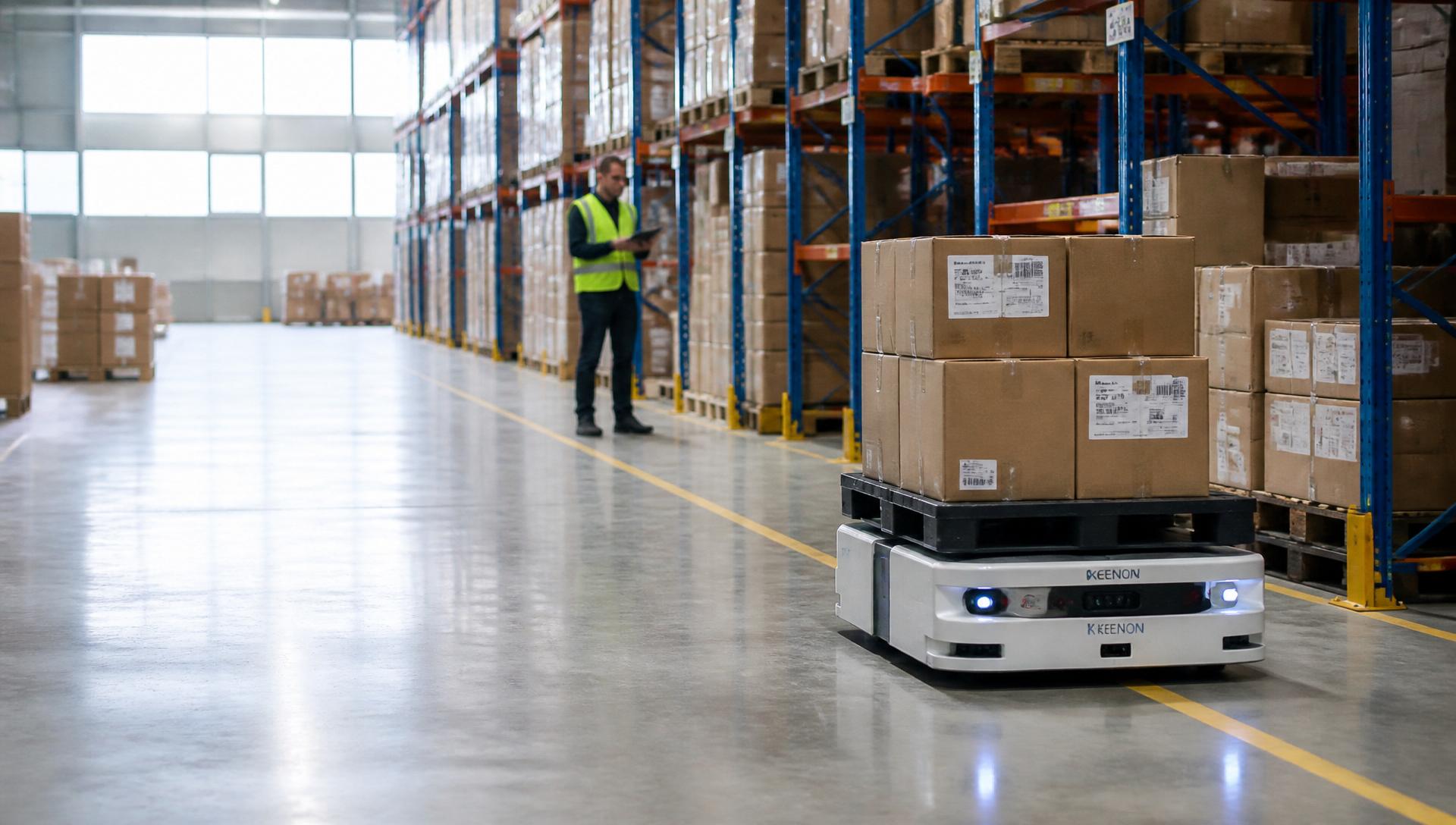
The KEENON S100 is a warehouse logistics robot designed to move loads between defined points. Typical routes may include:
- Goods-in to storage
- Storage to pick faces
- Production areas to dispatch
- Stores to healthcare or back-of-house areas
The S100 is not a humanoid and does not need to be. Its job is to move loads consistently while operatives remain focused on picking, packing, production or inventory control.
Warehouse logistics robots are most suitable where the same internal transport journeys happen repeatedly and where carrying or walking creates fatigue, delays or manual-handling exposure.
A site survey is important. A route must have suitable floor conditions, traffic arrangements, access and charging provision. The aim is not to automate every movement, but to identify the routes where automation has a clear operational purpose.
XBOT: automated coffee service
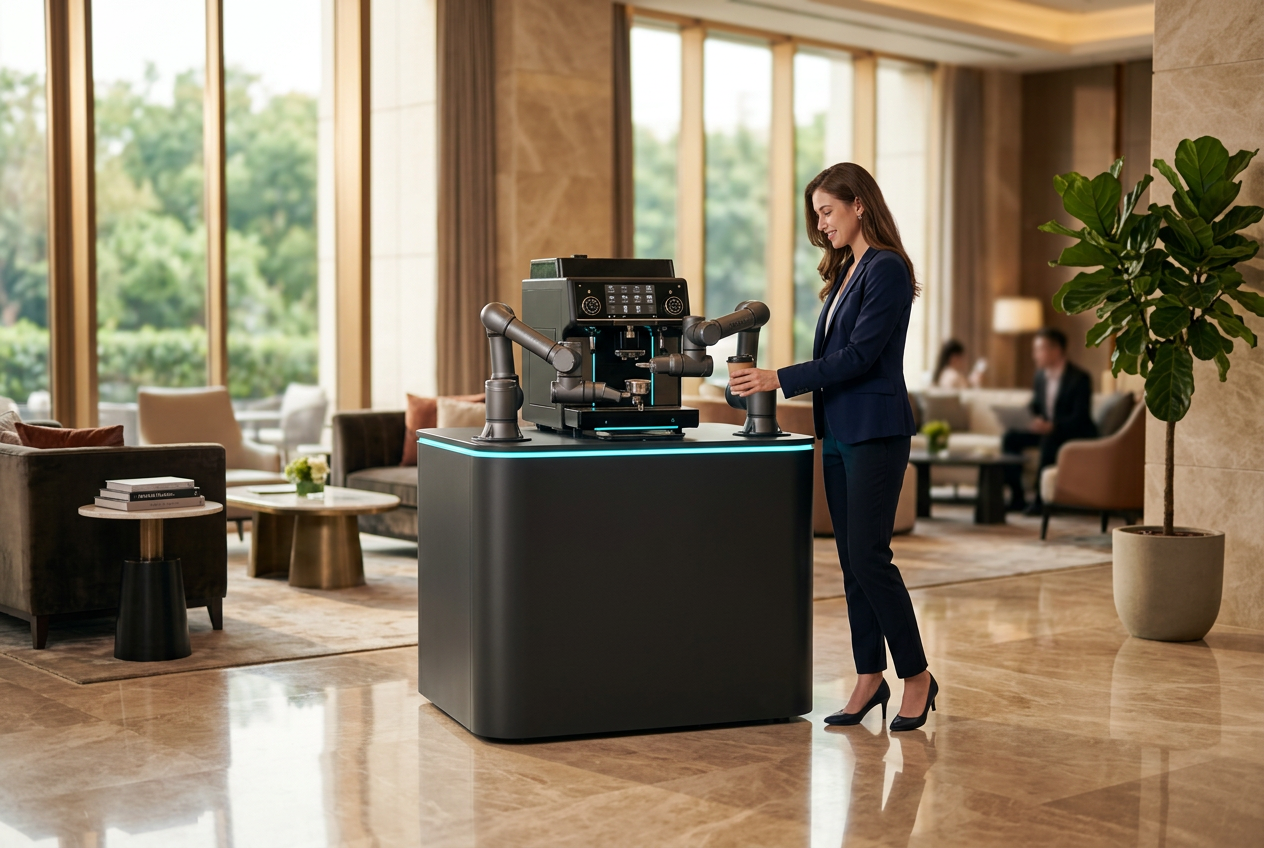
The XBOT S PRO robotic coffee machine is designed for customer-facing beverage service. It can suit:
- Hotel lobbies
- Office buildings
- Universities
- Retail centres
- Visitor attractions
- Transport hubs
- Healthcare facilities
The XBOT is different from a humanoid because it does not need to move around the site or hold a conversation. Its value comes from providing a consistent coffee offer in a compact, self-contained format.
It can be useful where a business wants to serve drinks but does not have the footfall, space or staffing model for a conventional café counter.
As with any food or beverage operation, the organisation still needs to manage replenishment, cleaning, customer support and compliance.
The three ways to deploy commercial service robots
Businesses do not all need to acquire robotics in the same way. The appropriate route depends on capital planning, operational certainty and the level of support required.
1. Outright purchase
An outright purchase gives the organisation ownership of the robot and control over the deployment. This can suit businesses that:
- Have a clearly defined long-term use case
- Want to own the equipment
- Have internal facilities or engineering capability
- Expect to operate the robot across a stable site
Support, maintenance, software and training should still be specified clearly in the proposal.
2. Hybrid ownership
A hybrid arrangement may combine ownership with finance, leasing or a managed support agreement. This can help organisations retain control of the asset while spreading payments or outsourcing some elements of maintenance and technical support.
The details vary by robot, site and service package. Fresh Mango Robotics sets out the proposed configuration and commercial terms in writing.
3. Robotics-as-a-Service
Robotics-as-a-Service is often the most accessible route for organisations testing robotics for the first time. The lead benefits are:
- Zero capital outlay
- A predictable monthly cost
- Maintenance and support included within the agreement
- Less technical responsibility for the customer
- An easier route to start with one robot and expand later
RaaS is particularly useful where a business wants to prove a deployment on one site before committing to a larger rollout. The agreement should clearly define the robot, software, maintenance, response arrangements, training and any integration work included.
Pricing depends on configuration and is set out in a written proposal following a site assessment.
How to choose the right robot
Before selecting a machine, document:
- The task: What repetitive work needs to be removed?
- The route: Where does the robot need to travel?
- The frequency: How often does the task happen during a shift?
- The environment: Are there stairs, lifts, narrow aisles, queues or mixed traffic?
- The people involved: Who will load, unload, supervise and maintain the robot?
- The handover: What happens when the robot reaches a limit?
- The measure: How will you assess whether the deployment is useful?
A free site survey and robotics consultation should come before a final recommendation. A good supplier should be willing to say when a humanoid is not the right first step.
Conclusion: choose the job before the robot
The commercial service robots that earn their keep in 2026 are not necessarily the most visually impressive. They are the machines that fit a real workflow:
- A DINERBOT moving meals through a busy restaurant
- A BUTLERBOT W3 delivering room service
- A KLEENBOT maintaining large commercial floors
- A KEENON S100 moving loads through a warehouse
- An XBOT providing coffee in a high-footfall location
- An XMAN humanoid robot welcoming and guiding people
Humanoid robots have a genuine role, but that role is specific. They add value where interaction, mobility and visible presence matter. Where the task is repetitive and physical, a specialist robot is often simpler to deploy and easier to measure.
The best first step is not to choose the robot that attracts the most attention. It is to identify the task that is consuming the most time, effort or operational capacity, then match the technology to it.
Last reviewed:
Frequently asked questions
What is a service robot?
A service robot is an autonomous or semi-autonomous machine that performs a practical task in a commercial environment. Examples include food delivery, room service, floor cleaning, warehouse transport, coffee preparation, greeting and wayfinding.
Are humanoid robots ready for UK businesses?
Some are ready for carefully selected customer-facing applications, particularly greeting, routine interaction, information delivery and wayfinding. The XMAN humanoid robot is best considered for environments where presence and interaction matter. Humanoids are not yet the simplest answer for every physical task. Delivery, cleaning and logistics robots are generally better suited to repetitive transport or floor-care work.
Which robot type suits which job?
Choose a humanoid for customer interaction, greeting and wayfinding. Choose a DINERBOT for restaurant delivery, a BUTLERBOT W3 for hotel or care deliveries, a KLEENBOT for repeatable floor cleaning, a KEENON S100 for internal load movement and an XBOT for automated coffee service.
Do robots replace staff?
Robots should support staff rather than replace the human parts of a role. They take on repetitive carrying, cleaning, transport or routine information tasks, allowing employees to focus on hospitality, care, judgement, problem-solving and customer relationships.
How do I start?
Begin with one clearly defined task and arrange a site survey. Fresh Mango Robotics can assess your environment, recommend the most suitable category, explain outright purchase, hybrid and RaaS options, and plan installation, training and ongoing support.
Talk to a robot supplier you can actually visit
We are based in Ripon, North Yorkshire, with engineers across the North of England. On-site demos as standard.
Related articles
Coffee Robots in UK Venues: What They Actually Do and Where They Fit
Read articleCommercial RoboticsWhat Happens in a Robot Site Survey? A Fresh Mango Engineer Walks You Through It
Read articleHospitalityPeak Times, Fewer Hands: How Restaurants Keep Service Flowing When Staffing Dips
Read articleKeep reading