
KEENON XMAN-R1 · Humanoid Service Robot
The humanoid service robot that keeps front of house working when your team cannot be everywhere
The KEENON XMAN-R1 brings AI-powered conversation and autonomous service delivery to hotels, leisure venues, hospitals, shops and corporate buildings — greeting visitors, answering the same questions tirelessly, escorting people where they need to go and carrying light items, so your people spend their shift on the service that only people can deliver. Supplied, installed, trained and supported across the UK by Fresh Mango Robotics.
Free site survey · No obligation · UK installation and support
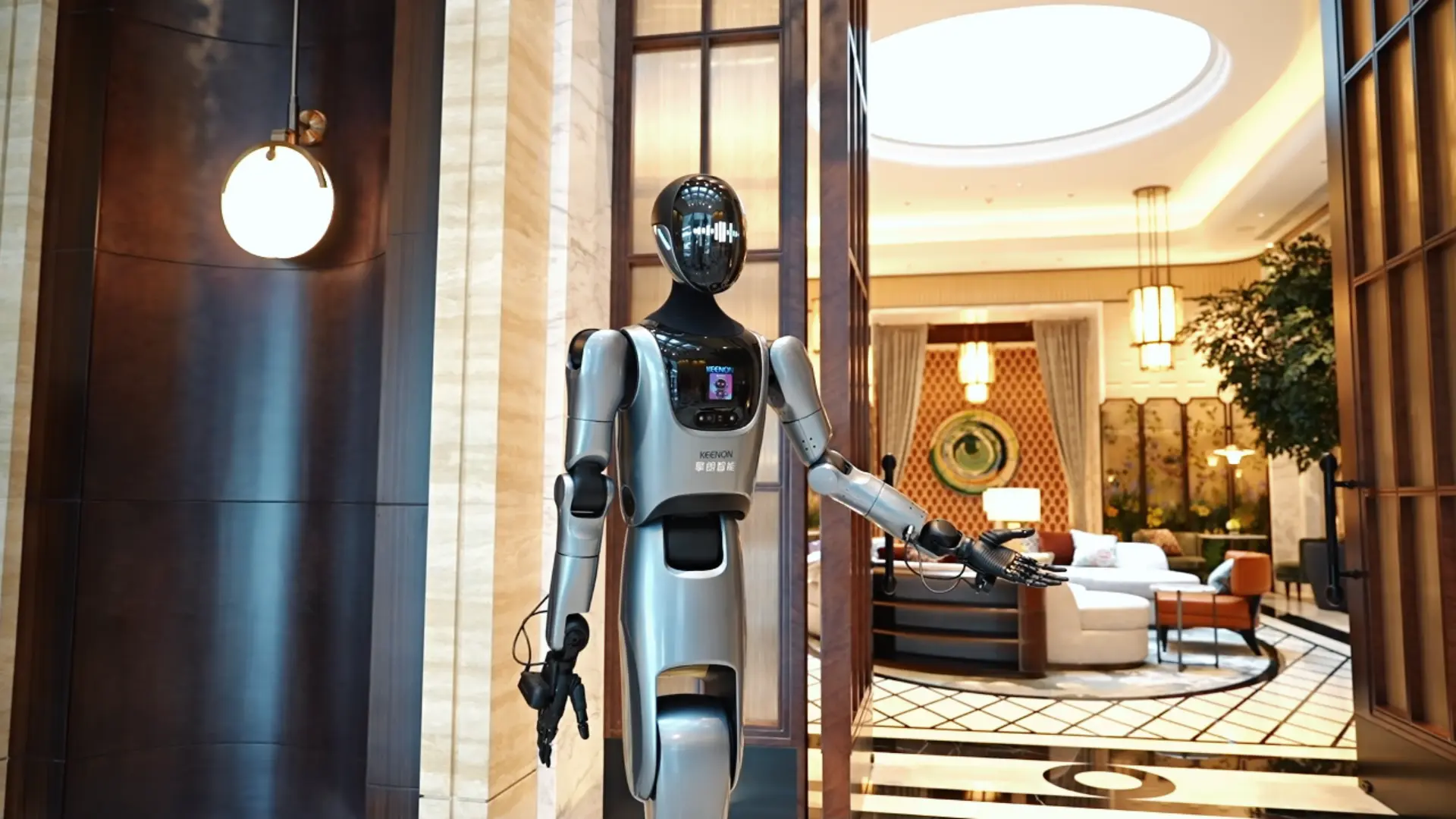
At a glance
Key selling points
Why the XMAN-R1 earns its place on the floor
Outcomes first: cover, consistency and customer experience. The engineering matters only because it delivers them.
AI-powered interaction guests actually respond to
Spoken, natural-language conversation rather than a touchscreen menu. Visitors ask for what they want in their own words, and the robot answers, guides or fetches — in the languages your site needs.
Autonomous service delivery, not a static kiosk
The XMAN-R1 moves. It meets people at the door, walks them towards a lift, carries a light item to a table or desk and returns to position on its own, without a member of staff steering it.
Workforce augmentation where cover is hardest
Early mornings, late evenings, weekends, sickness and rota gaps are where service quality slips. The robot holds the routine front-of-house baseline so your people are never the only line of cover.
Works as part of a robot team
Designed to sit at the front of a wider fleet — food-running, room-service delivery, heavy transport and floor cleaning robots behind it. One estate, one supplier, one support desk.
A commercial differentiator, measurably
A humanoid on the floor creates dwell time, conversation, press interest and social content. It is the rare operational investment that also markets the venue it works in.
Safety-first design for public floors
Multi-sensor perception and a stable wheeled base mean predictable movement in crowded foyers, aisles and corridors, at a walking pace suited to shared space.
Product overview
What is the KEENON XMAN-R1?
The XMAN-R1 is KEENON's humanoid service robot: a commercial machine designed to work in front of people rather than behind the scenes. Where a delivery robot moves trays and a cleaning robot covers floors, the XMAN-R1 is built around interaction — welcoming, informing, guiding and handing over.
It stands at roughly human height on a wheeled base, which is a deliberate commercial choice: human scale makes face-to-face conversation feel natural, while wheels give the smooth, stable, quiet movement that a hotel lobby or shop floor needs. Articulated dual arms let it gesture, present and carry light items as part of an interaction rather than as a separate errand.
Behind the behaviour sits KEENON's KOM2.0 vision-language-action model, trained on service-industry data rather than laboratory tasks. That is the practical difference from earlier interaction robots: instead of navigating a scripted menu, a visitor asks for something in plain speech and the robot works out the sequence of actions needed to deal with it. It is AI automation applied to a real service floor, not a laboratory demo.
KEENON introduced the XMAN-R1 in March 2025 and it entered commercial hotel service from late 2025, working alongside the same specialist KEENON robots UK operators already run — food-running DINERBOTs, enclosed BUTLERBOT room-service delivery, KEENON S100 heavy transport and KLEENBOT floor cleaning. That general-purpose plus special-purpose pairing is how humanoids are being deployed commercially, and it is how we plan UK installations.
Published specifications
- Height
- Approx. 172 cm — human scale for face-to-face service
- Weight
- Approx. 110 kg
- Base
- Wheeled chassis for smooth, stable indoor movement
- Whole-body articulation
- 36 degrees of freedom, including dual arms
- Perception
- Twin LiDAR, four depth cameras, four HD wide-angle cameras
- Onboard AI compute
- Approx. 275 TOPS
- AI model
- KEENON KOM2.0 vision-language-action model for service tasks
- Remote operation
- VR dual-arm teleoperation for supervised tasks
- Carry capacity
- Light-item handling (approx. 3 kg)
- Announced
- March 2025; first hotel deployments from late 2025
Figures reflect published manufacturer information. Final UK configuration, availability and lead time are confirmed at enquiry.
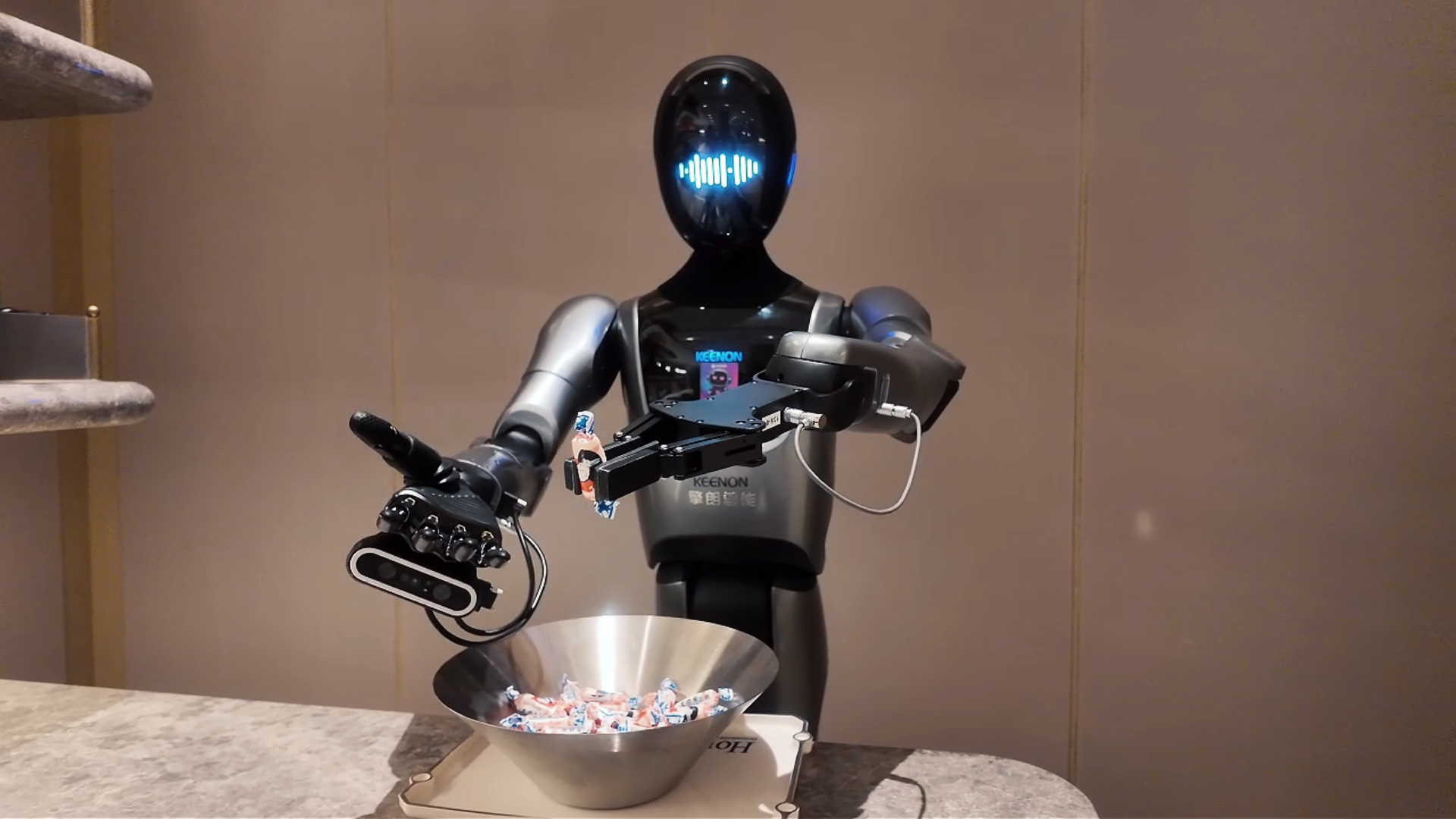
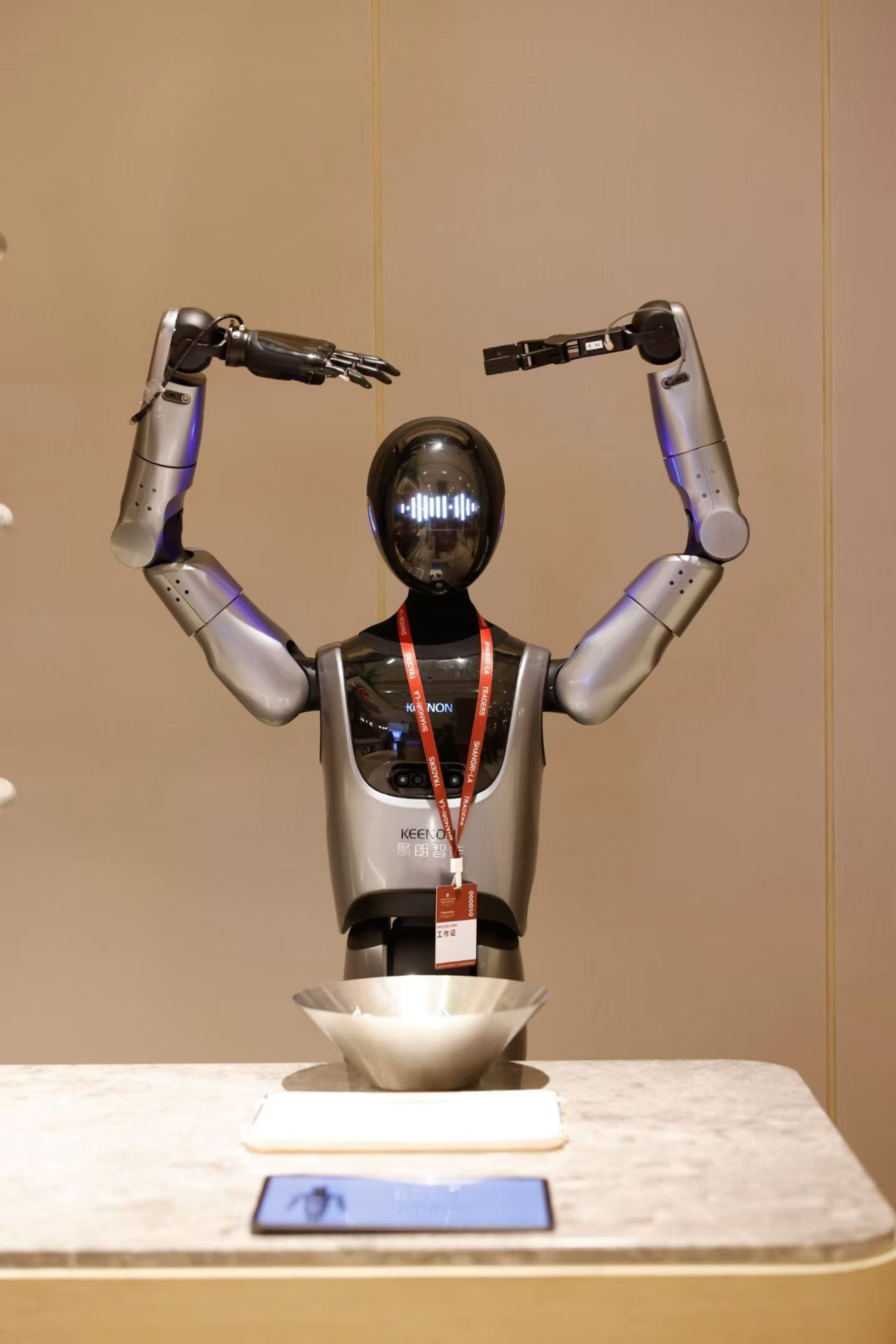
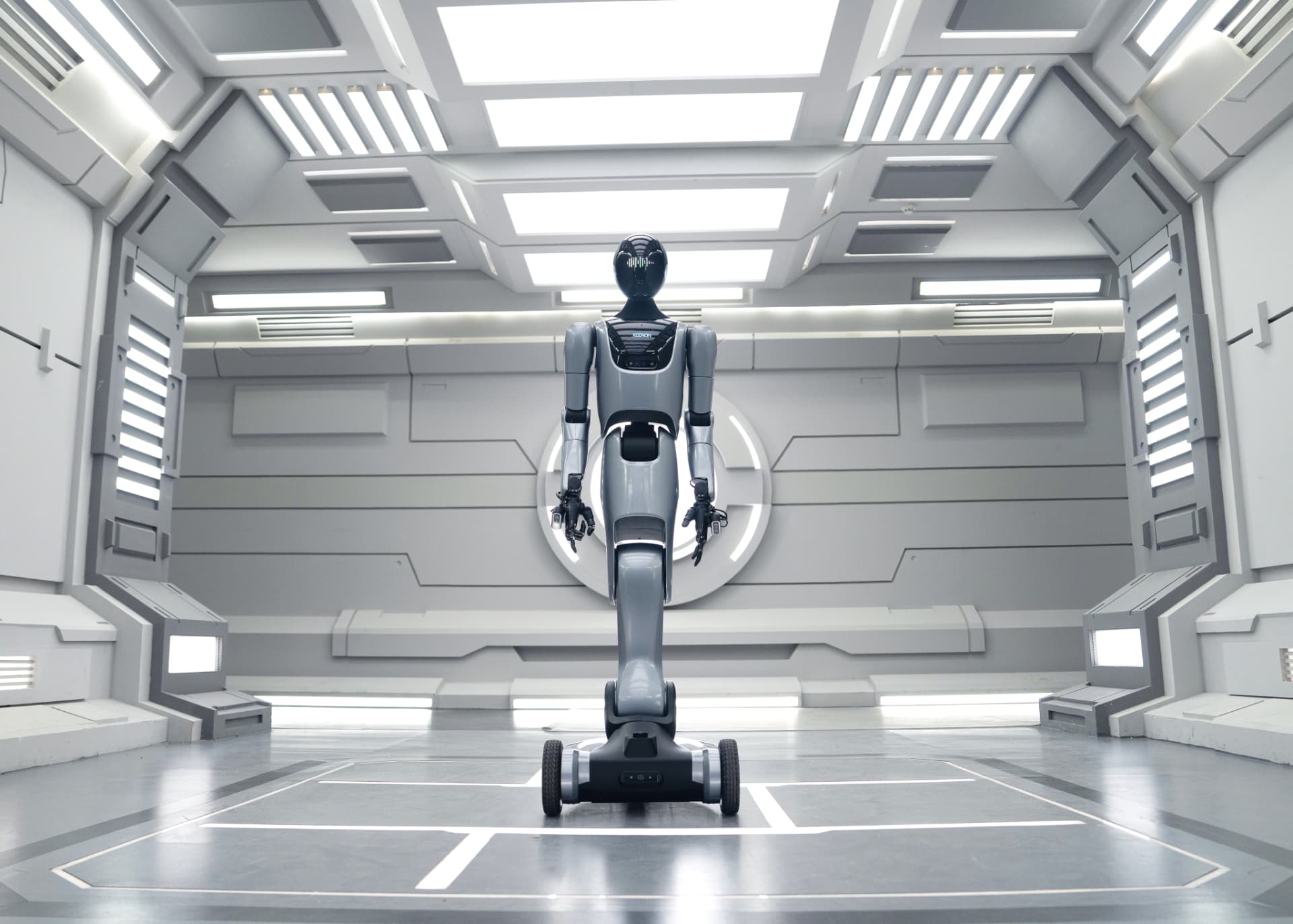
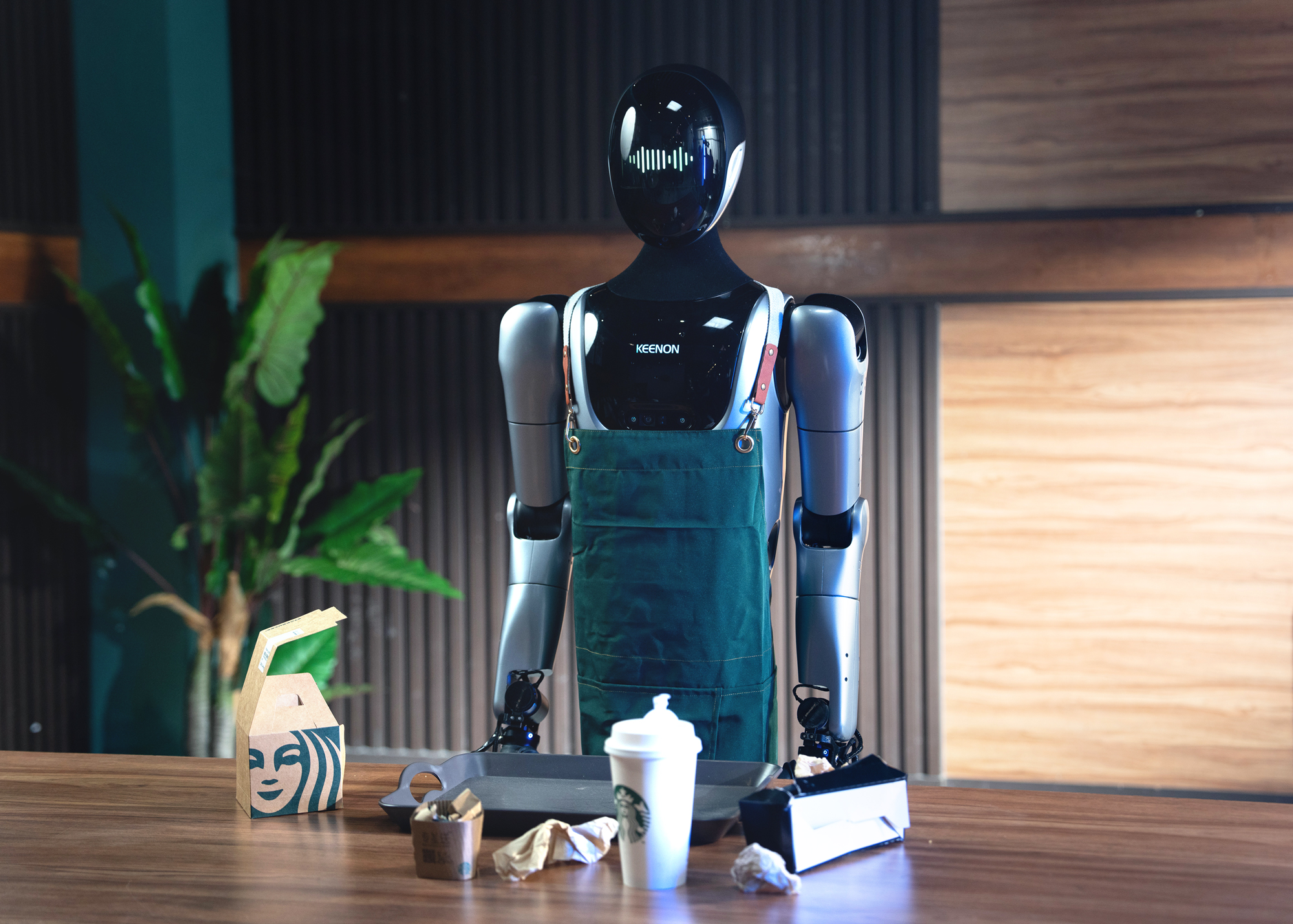
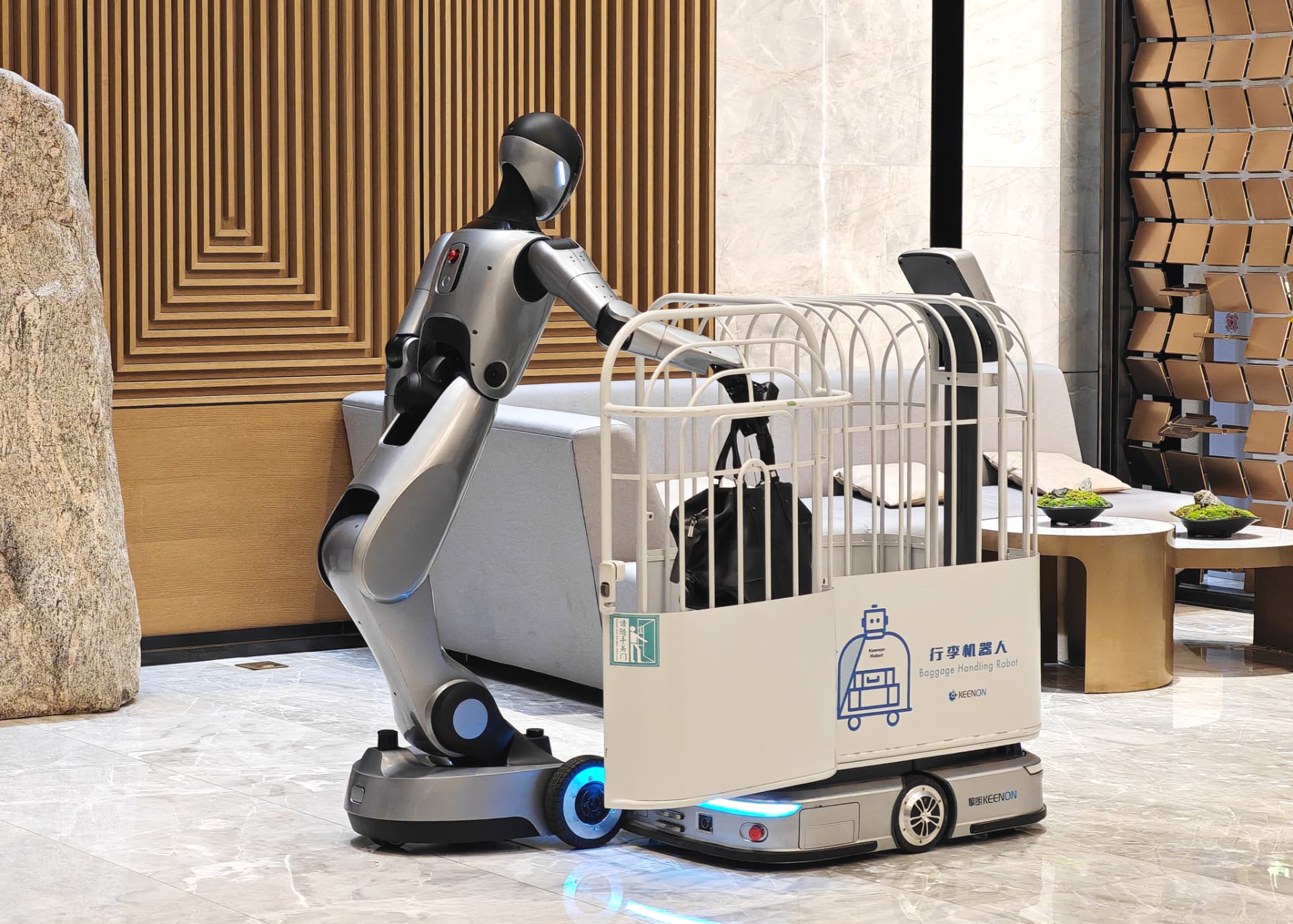
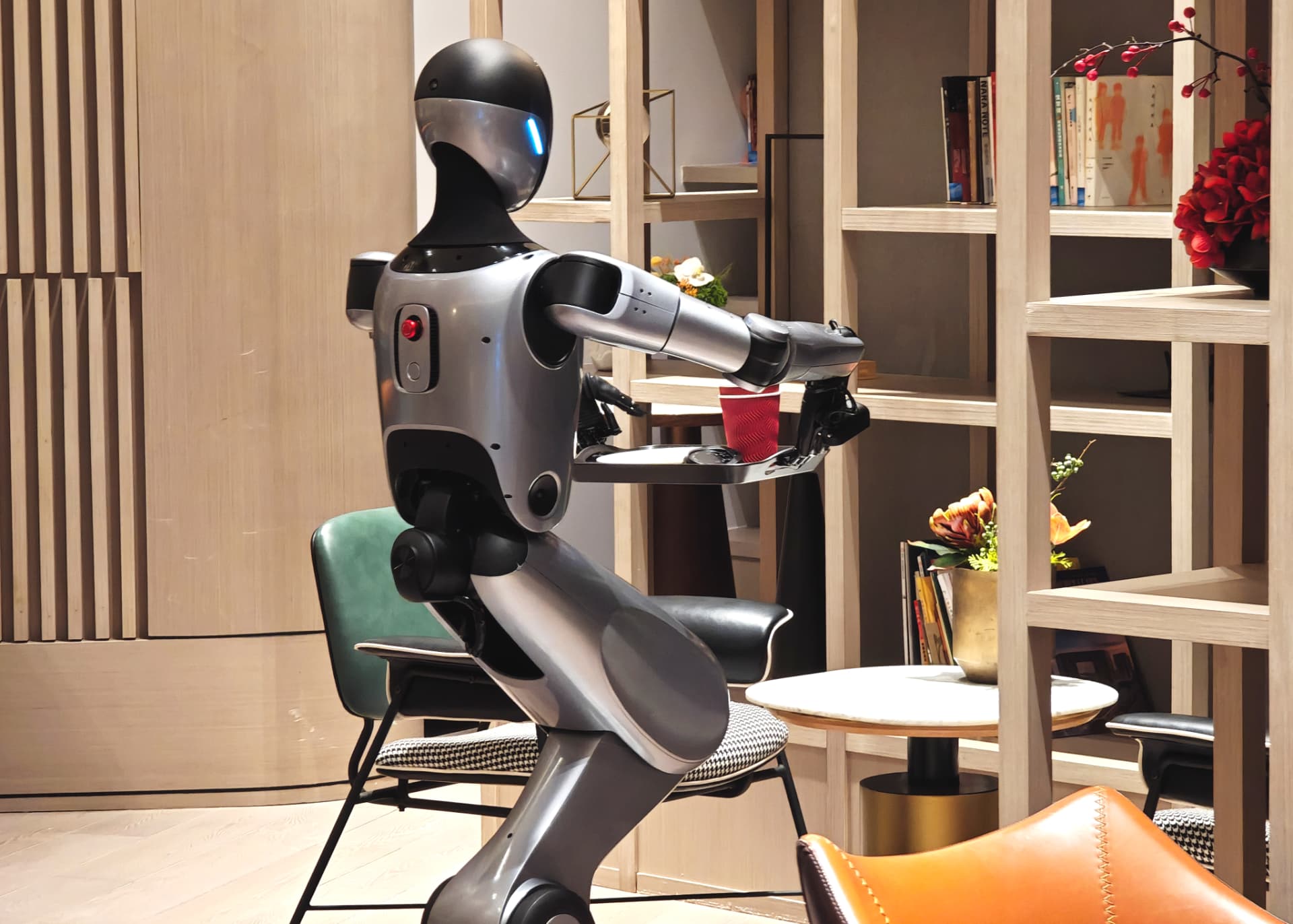
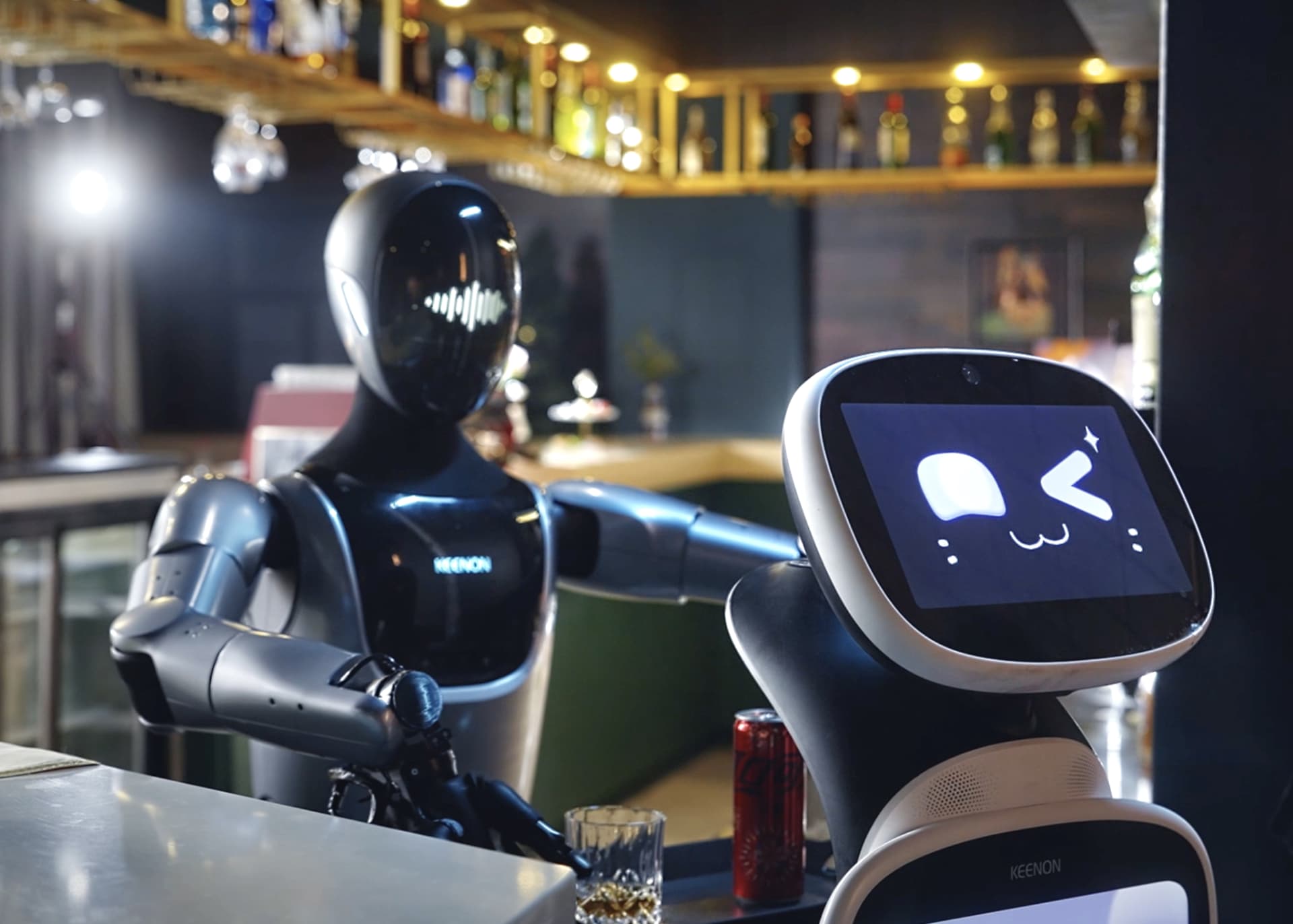
XMAN-R1 in service
The KEENON XMAN-R1 in customer-facing settings
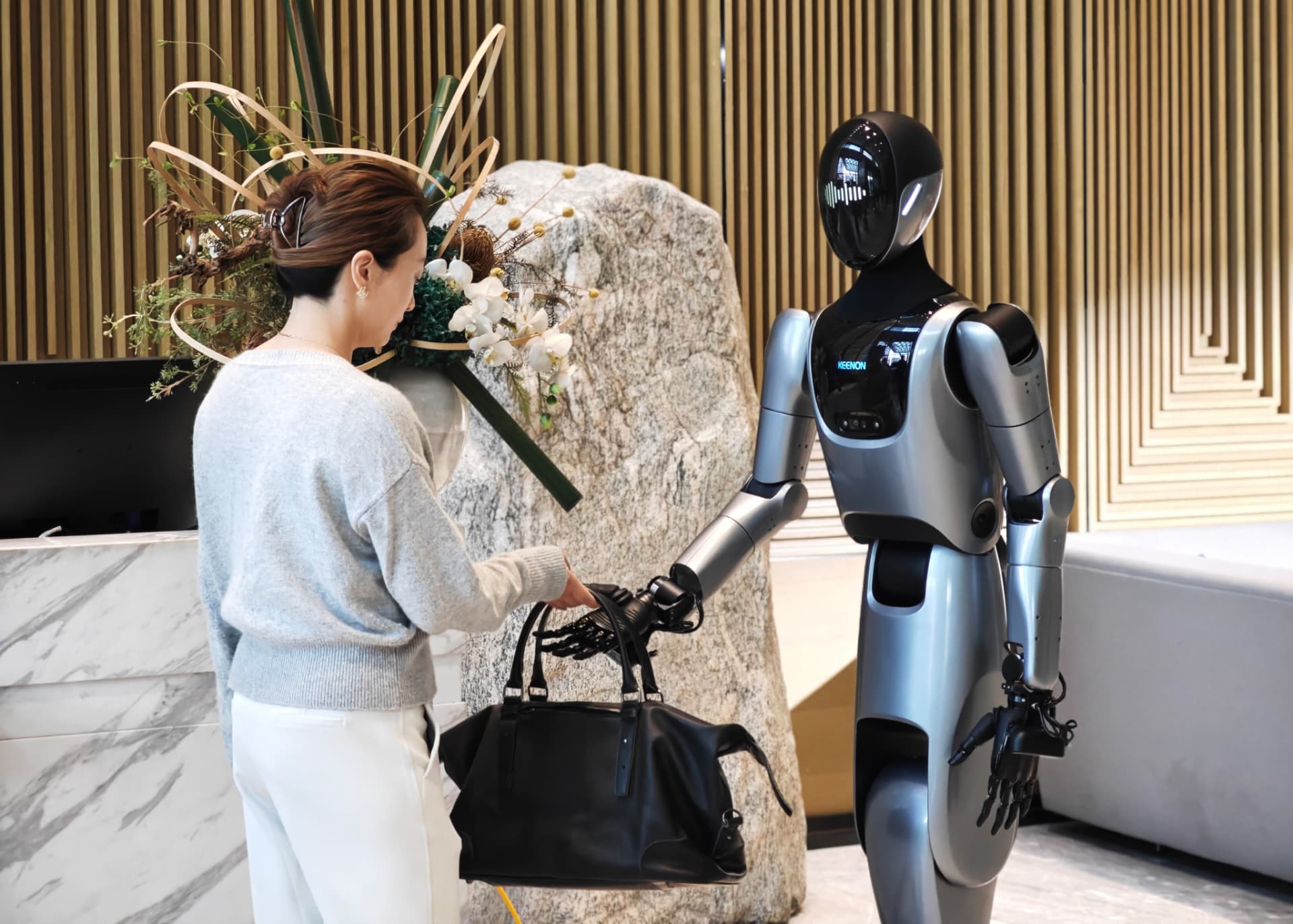
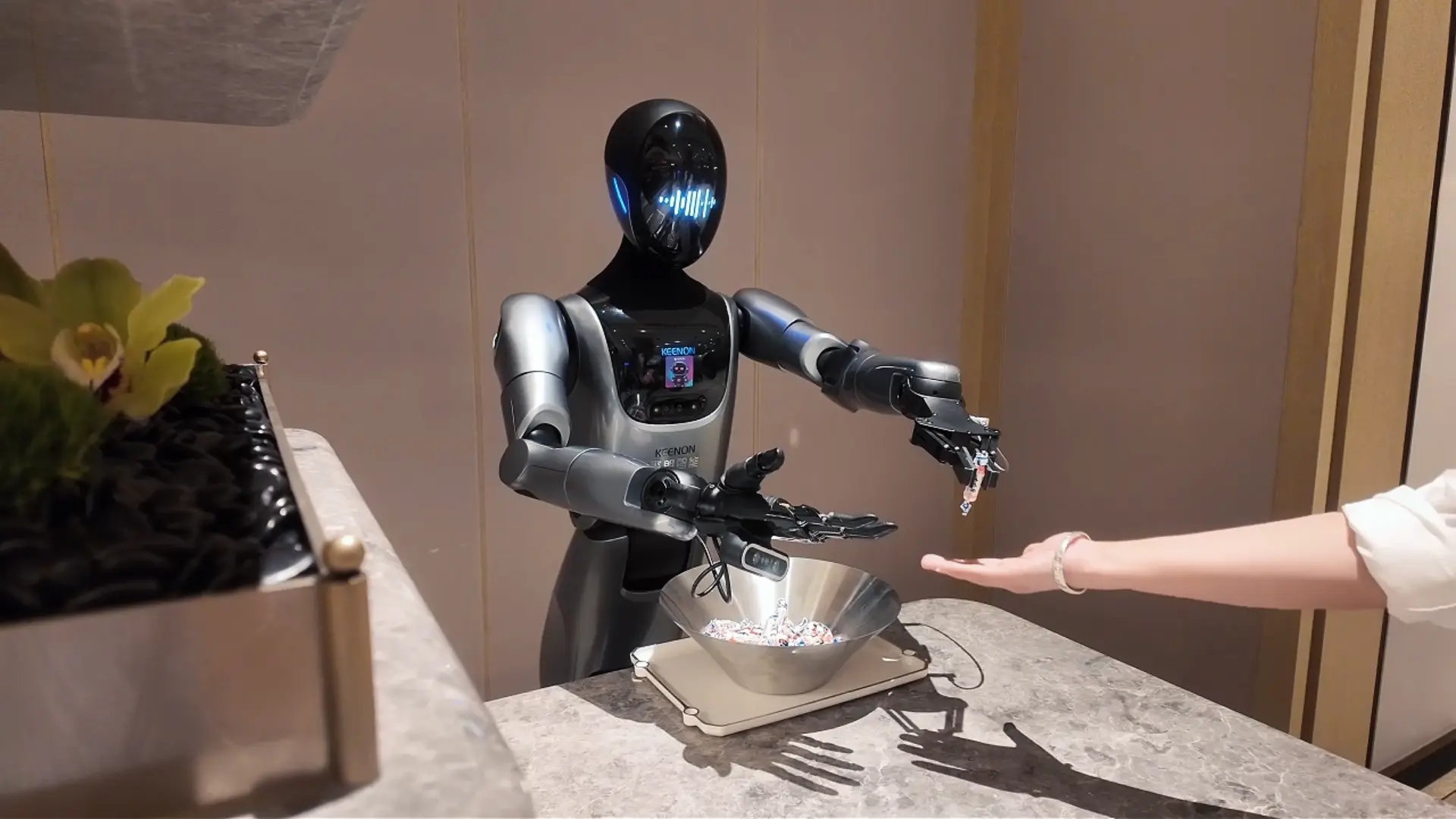
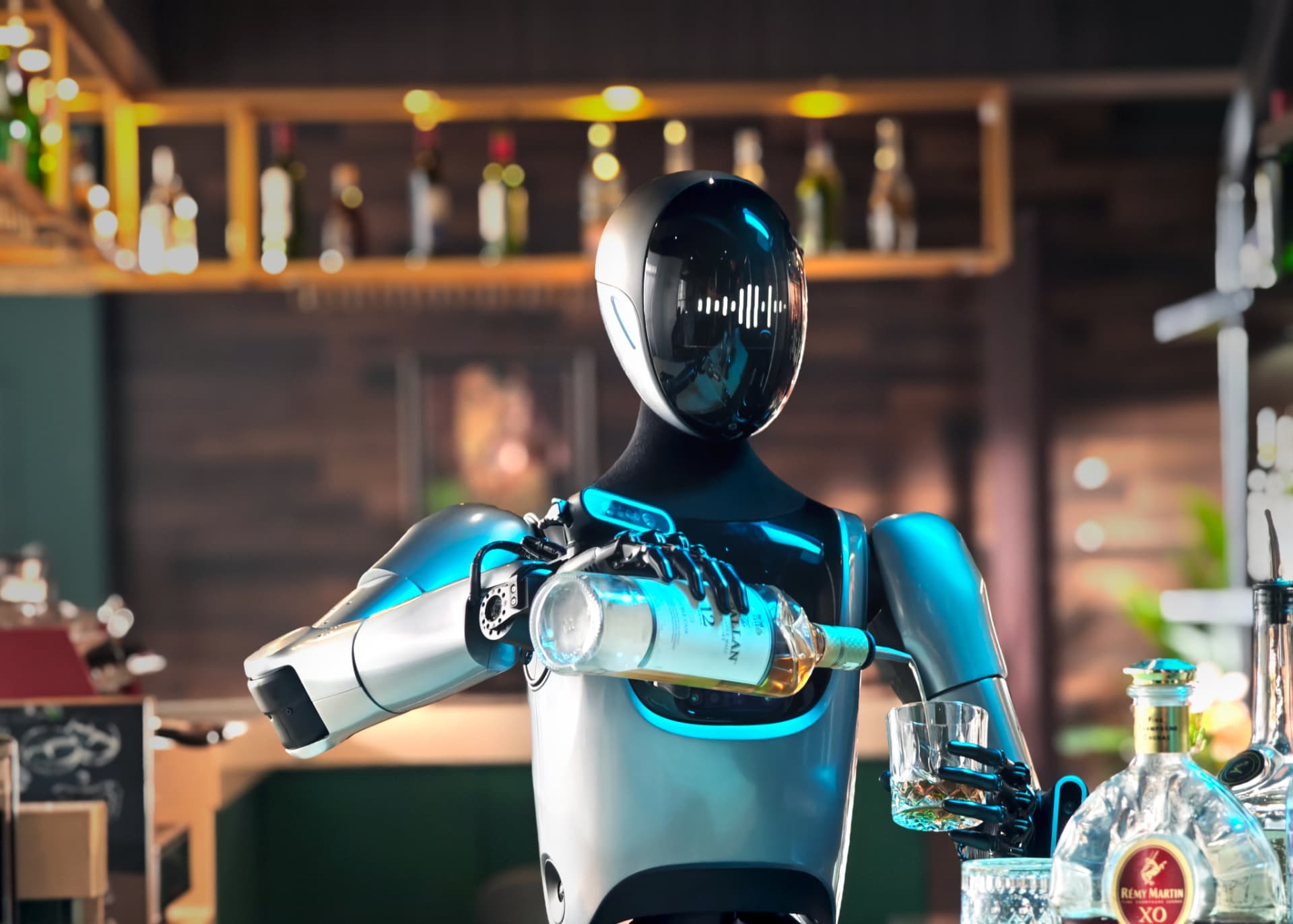
Manufacturer imagery showing greeting, guest interaction, dual-arm hand-over, barista and bar service, baggage handling, tray carrying, robot collaboration and the wheeled base that keeps the robot stable on commercial floors.

The business case
Why UK organisations are investing in humanoid robots
Not because they are impressive — because the arithmetic of staffing customer-facing roles has changed.
Recruitment is the constraint, not demand
UK hospitality, retail, leisure and care have persistent vacancy rates in exactly the customer-facing roles that shape reputation. Automation of the repetitive part of those roles is now a practical response, not a futuristic one.
Labour cost per hour keeps rising
Wage floors and employer costs move in one direction. Organisations are fixing the cost of the predictable part of service delivery while keeping people for the parts that create value.
Service expectations have not softened
Customers do not accept a reduced standard because a rota was short. A robot holds the baseline so the standard does not depend on who turned up.
AI has become physically useful
Vision-language-action models let a robot act on plain spoken instruction. That is the shift that moved humanoids from exhibition pieces to working service equipment.
Workforce augmentation is the sensible model
Boards are not buying robots to remove teams; they are building a hybrid front of house where robots absorb repetition and people handle relationships.
Early adopters gain more than efficiency
Being first in your sector or town produces press coverage, footfall and recruitment advantage that later adopters cannot buy back.
Core capabilities
What the XMAN-R1 actually does, and why it matters
Every capability below is paired with the operational outcome it produces. Exact feature availability is confirmed against the manufacturer specification at enquiry.
Conversational guest interaction
Spoken question-and-answer in natural language, with multi-language handling for international visitors. The robot greets, explains, confirms and repeats without fatigue or variation between shifts.
Multi-sensor spatial awareness
Twin LiDAR plus depth and wide-angle vision give continuous awareness of people, trolleys, luggage and furniture, so the robot behaves predictably in genuinely busy commercial space.
Autonomous navigation and wayfinding
It maps your floor plan once, then routes itself to reception, lifts, tables, departments or meeting rooms — and escorts visitors there rather than pointing at a sign.
Action planning from plain instructions
A vision-language-action model turns a spoken request into a sequence of physical steps, which is what separates the XMAN-R1 from scripted, menu-driven interaction robots.
Light item handling and hand-off
Dual arms allow the robot to pick up, carry and present light items — a welcome pack, a menu, a bottle of water, an amenity — as part of an interaction rather than as a separate delivery run.
Fleet coordination with specialist robots
The humanoid takes the human-facing work and hands the logistics to purpose-built robots: enclosed room-service delivery, food running, heavy load transport and scrubber-drier cleaning.
Supervised teleoperation
Where a task benefits from a human in the loop, the arms can be operated remotely, giving your team a controlled fallback instead of an outage.
Configurable content and brand voice
Greetings, information, promotions, opening hours and seasonal messaging are yours to set and update, so the robot speaks in your organisation's voice, not a generic one.
Applications & use cases
Where the XMAN-R1 works — and what it does there
Each environment has its own pressure points. For every one, here is the problem set, the tasks the robot performs, the operational benefit, the customer-experience gain, and how AI interaction makes the difference. For sector-specific detail, see our guides to hospitality robotics, healthcare robotics and retail robots.
Hospitality & Leisure
Hospitality
Hospitality: how we helpProblems solved
- Front-of-house cover thins exactly when arrivals peak — coach parties, late check-ins, breakfast rushes and event spillover.
- Reception staff repeat the same directions, opening hours and Wi-Fi instructions hundreds of times per shift.
- Rota gaps from sickness, holidays and unfilled shifts leave the desk under-resourced at the times guests most notice.
- International guests struggle with English-only signage and verbal directions, creating friction at every touchpoint.
Tasks the robot performs
- Greet arriving guests and acknowledge them while the desk completes check-ins.
- Answer routine questions — breakfast times, spa access, parking, Wi-Fi, gym hours, checkout — in natural spoken language.
- Escort guests to lifts, meeting rooms, the restaurant or function suite.
- Carry light items such as welcome packs, menus or amenity trays as part of an interaction.
- Hand in-room deliveries to a BUTLERBOT W3 for enclosed, PIN-protected room service.
Expected operational benefits
- Reception staff freed from repetitive questioning to handle complex check-ins, upgrades and service recovery.
- Consistent welcome standard across every shift, regardless of who turned up.
- Cover through sickness, holidays and split-site rota gaps without overtime or agency spend.
- Interaction data reveals the most common questions and peak patterns to inform signage, rota and layout decisions.
Customer experience improvements
Guests are acknowledged the moment they walk in, even when the desk is mid-transaction. Routine questions are answered instantly without joining a queue. International visitors receive the same quality of information as English speakers. A humanoid welcome is a story guests share — the rare operational improvement that also builds brand recall.
How AI interaction improves service delivery
Natural-language spoken interaction means a guest asks for what they want in their own words, not by navigating a touchscreen menu. The KOM2.0 vision-language-action model turns a spoken request into a sequence of actions — greet, explain, escort, hand over — so the robot responds usefully rather than reading a script. Multi-language handling gives international guests the same welcome as English speakers.
Hotels
Hotels: how we helpProblems solved
- Lobby congestion at peak check-in and checkout leaves guests waiting and staff overwhelmed.
- Guests in large or multi-floor properties routinely get lost finding rooms, function suites and amenities.
- Night-time concierge cover is thin, yet guests still need information, directions and assistance after hours.
- VIP and arrival experiences vary by who is on shift, undermining brand consistency across the property.
Tasks the robot performs
- Welcome guests in the lobby and guide them through check-in steps while the desk processes paperwork.
- Escort guests to the correct lift bank, floor and corridor rather than pointing at a sign.
- Explain hotel facilities — restaurant hours, spa booking, gym location, business centre — on request.
- Handle late-night information requests without waking or calling the night manager.
- Coordinate with BUTLERBOT W3 for enclosed room-service delivery and KEENON S100 for luggage transport.
Expected operational benefits
- A consistent 24/7 lobby presence at a fixed cost rather than premium overnight hourly rates.
- Night manager workload reduced as routine guest queries are handled autonomously.
- Uniform arrival experience regardless of shift, agency cover or staffing level.
- Concierge and guest relations staff freed for high-value requests, upselling and relationship-building.
Customer experience improvements
Guests never find an empty desk. They are guided personally to their floor, not handed a map. Night-time queries are answered without picking up a phone. The arrival feels considered and modern, which is what guests now expect from a property that invests in technology.
How AI interaction improves service delivery
Contextual answers based on your hotel's specific facilities, layout and policies — not generic responses. Language switching detects a guest's first words and continues in their language. The robot learns from recurring interaction patterns, so the most-asked questions get faster, more accurate answers over time.
Retail
Retail
Retail: how we helpProblems solved
- Every unattended customer is a conversion risk, and floor cover is thinnest exactly when footfall peaks.
- Shoppers in large stores, showrooms and shopping centres cannot find departments, collection points or facilities.
- Repetitive directional and promotional questions consume staff time that should go to advice and selling.
- Diverse catchment areas include shoppers who prefer languages other than English.
Tasks the robot performs
- Welcome shoppers on entry and route them to departments, collection points and fitting areas.
- Present offers, launches, loyalty messaging and seasonal promotions at the door.
- Carry light items — a brochure, a sample, a small basket — as part of a guidance interaction.
- Create a destination feature that draws footfall into the space.
- Free colleagues for advice, fitting rooms, demonstrations and closing sales.
Expected operational benefits
- Consistent floor presence during peak trading without additional headcount.
- Staff redeployed from directions to conversion — advice, fitting, upselling.
- A measurable footfall draw that increases dwell time and social sharing.
- Extended trading-hours presence at a fixed cost rather than premium rates.
Customer experience improvements
Shoppers are acknowledged on entry, guided to what they came for, and presented with relevant offers without hunting for a colleague. For diverse catchments, multi-language interaction means the same welcome for every visitor. A humanoid in-store is a reason to visit in itself.
How AI interaction improves service delivery
Shoppers ask for products and locations in plain speech — 'Where are the children's shoes?' — and receive a spoken answer plus an escort, not a touchscreen map. Promotional content is configurable and updateable by the retailer, so the robot delivers current offers in your brand voice. Multi-language handling serves international and non-English-speaking customers without specialist staff.
Healthcare
Healthcare
Healthcare: how we helpProblems solved
- Reception and wayfinding absorb an enormous amount of clinical and administrative time.
- Patients and visitors get lost in complex hospital estates, causing missed and late appointments.
- Non-clinical questions — directions, visiting hours, café location, parking — block the reception desk.
- Diverse patient populations include many who prefer languages other than English.
Tasks the robot performs
- Greet patients and visitors on arrival and direct them to the correct department, clinic or ward.
- Answer non-clinical questions — visiting hours, facility locations, parking, accessibility routes.
- Escort patients to key points rather than giving verbal directions that are easily forgotten.
- Provide consistent multi-language reception support across opening hours.
- Hand meal, linen and supply deliveries to a BUTLERBOT W3 to reduce carrying work for clinical staff.
Expected operational benefits
- Clinical and administrative staff stay on clinical work rather than giving directions.
- Fewer missed and late appointments caused by patients arriving at the wrong department.
- Consistent reception standard across shifts without agency or overtime spend.
- Reduced carrying and walking workload for nurses and healthcare assistants through fleet coordination.
Customer experience improvements
Patients and visitors are greeted immediately, directed clearly, and escorted rather than pointed at a sign. For anxious patients, a calm, repeatable interaction reduces stress. Multi-language support means every visitor gets the same quality of direction, regardless of first language.
How AI interaction improves service delivery
Natural-language wayfinding lets a patient ask 'Where is the fracture clinic?' in their own words and be guided there. Multi-language handling serves diverse patient populations without recruiting specialist reception staff. The robot delivers the same accurate information every time, which is critical in healthcare settings where inconsistent directions have real consequences.
Private Hospitals
Private Hospitals: how we helpProblems solved
- Private patients expect a premium, concierge-level experience that stretched staff cannot always deliver.
- Complex multi-specialist estates make wayfinding to consultant suites and clinics difficult.
- VIP and dignity requirements demand personal escorting, not a map and a corridor number.
- Out-of-hours and weekend admissions lack the reception presence private patients expect.
Tasks the robot performs
- Greet private patients personally on arrival and acknowledge them while reception processes admissions.
- Escort patients to consultant suites, treatment rooms and day-case wards with dignity.
- Explain facility amenities — patient lounge, café, pharmacy, discharge area — on request.
- Coordinate with BUTLERBOT W3 for linen, meal and supply delivery to maintain a calm clinical environment.
- Provide a consistent reception presence during out-of-hours and weekend periods.
Expected operational benefits
- Premium patient experience delivered at a lower staffing cost than dedicated patient liaison roles.
- Patient liaison and concierge staff freed for high-value personal interactions and complex cases.
- Consistent five-star welcome across every shift and every admission window.
- Out-of-hours cover without premium overtime or on-call costs.
Customer experience improvements
Private patients are greeted like a guest, not processed like a number. They are escorted personally to their consultant, not handed a map. The atmosphere stays calm, dignified and premium — the standard private healthcare promises in its marketing.
How AI interaction improves service delivery
Personalised greeting capability means the robot can welcome a patient by name where appropriate. Context-aware facility information covers your specific consultant suites, schedules and amenities. The interaction is dignified, non-judgmental and repeatable — exactly what private patients expect from a premium environment.
Care Facilities
Care Facilities: how we helpProblems solved
- Reception cover is thin in evenings and weekends when visitors arrive, yet staff are stretched across care duties.
- Visitors need direction to resident rooms in layouts they do not know.
- Repetitive non-care questions — visiting hours, facility location, meal times — pull carers away from residents.
- Staff are stretched between direct care and front-of-house duties with no slack in the rota.
Tasks the robot performs
- Greet visitors on arrival and direct them to the correct resident room or communal area.
- Answer visiting hours, facility and activity questions without involving care staff.
- Escort visitors through the home to lounges, dining areas and gardens.
- Hand meal, drink and linen deliveries to a BUTLERBOT W3 to reduce walking and carrying for carers.
- Provide a reception presence during evening and weekend visiting periods.
Expected operational benefits
- Carers stay on direct resident care rather than reception and direction-giving.
- Consistent visitor welcome during evenings and weekends without overtime.
- Reduced walking and carrying workload for carers through fleet coordination with delivery robots.
- Fewer interruptions to care routines from non-care questions at the desk.
Customer experience improvements
Visitors are welcomed and guided to their relative's room, not left to wander. The reception is staffed even at quiet evening and weekend times. For elderly visitors, patient, clear, repeatable spoken directions are easier to follow than a printed map.
How AI interaction improves service delivery
Patient, repeatable interaction suited to elderly visitors who may need directions repeated. Clear spoken directions at an appropriate pace, with the ability to repeat without any sign of impatience. Multi-language handling supports diverse resident and visitor populations, including those whose first language is not English.
Corporate & Visitor Spaces
Corporate Reception Areas
Corporate Reception Areas: how we helpProblems solved
- Reception cover is idle for much of the day then overwhelmed during events, board meetings and client visits.
- Visitor sign-in and wayfinding in multi-tenant or multi-floor buildings is repetitive and time-consuming.
- Lunch cover, holidays and sickness leave the front desk empty at exactly the wrong moment.
- Arriving clients form an impression of the company's technology position in the first thirty seconds.
Tasks the robot performs
- Welcome visitors on arrival and guide them through sign-in procedures.
- Escort clients to meeting rooms, boardrooms and specific floors.
- Answer building and facility questions — Wi-Fi, refreshments, toilets, exits.
- Signal a credible, technology-forward position to clients from the moment they arrive.
- Fit alongside delivery and cleaning robots operating across the same building.
Expected operational benefits
- Reduce dedicated reception cost without losing visitor management quality.
- Cover lunch periods, holidays, sickness and event surges without agency temp spend.
- Consistent visitor management across multiple tenants or floors.
- A visible technology investment that reinforces brand positioning on every client visit.
Customer experience improvements
Clients are acknowledged and guided on arrival — no empty desk, no standing in a foyer. The first impression is professional and modern, which matters in competitive pitching and partnership contexts. International clients receive multi-language welcome without specialist staff.
How AI interaction improves service delivery
Natural-language visitor handling means a client says 'I'm here to see the partners on floor four' and is guided there, not asked to use a tablet. Building-specific information — meeting room names, floor directories, facility details — is configured to your premises. Multi-language handling supports international clients from the first hello.
Visitor Centres
Visitor Centres: how we helpProblems solved
- Seasonal and variable footfall means staffing levels are either over- or under-scaled for most of the year.
- The same twenty questions — directions, opening times, exhibit locations, café, toilets — are asked all day, every day.
- Information cover is thinnest during off-peak periods when the centre is still open but staff are redeployed.
- Tourist and visitor catchments include many who prefer languages other than English.
Tasks the robot performs
- Greet visitors on arrival and answer exhibit, facility and location questions.
- Direct visitors to entrances, galleries, cafés, toilets and specific exhibits.
- Present promotional and seasonal programming content.
- Extend an information presence into quieter periods and off-peak hours.
- Free specialist staff for complex, educational or interactive queries.
Expected operational benefits
- Consistent information coverage across variable and seasonal footfall.
- Specialist staff redeployed from repetitive questions to education and engagement.
- Extended opening-hours presence at a fixed cost.
- Scalable cover for peak season without recruiting seasonal temps.
Customer experience improvements
Visitors get instant answers without queueing at an information desk. They are guided to what they came to see, not left reading a floor plan. Multi-language support means international tourists get the same quality of visit as local visitors. A humanoid in a visitor centre is itself a draw.
How AI interaction improves service delivery
Natural-language Q&A means a visitor asks 'Where is the Roman gallery?' and gets a spoken answer and an escort, not a map reference. Content is updateable for seasonal programming, temporary exhibitions and events. Multi-language handling serves international tourist catchments without multilingual staff on every shift.
Events, Travel & Transport
Events & Exhibitions
Events & Exhibitions: how we helpProblems solved
- Queue perception and first impressions determine whether visitors stay or walk out.
- The same directional and programme questions are asked thousands of times across an event.
- Sponsors and exhibitors pay for visibility but footfall does not always reach their stands.
- Cover across large venues is expensive and inconsistent between staff members.
Tasks the robot performs
- Direct visitors to specific stands, halls, session rooms and facilities.
- Answer programme, schedule and venue questions in natural spoken language.
- Draw crowds to sponsor activations, launches and featured stands.
- Present sponsor and exhibitor messaging as part of directional interactions.
- Provide a roaming information point that moves to where the queues are forming.
Expected operational benefits
- Scalable information coverage across large venues without proportional staffing increases.
- Sponsor value increased through directed footfall and branded messaging.
- Reduced staffing cost per square metre of venue covered.
- Consistent information quality across every interaction, every day of the event.
Customer experience improvements
Visitors are guided, not lost. They get instant programme and location information without queueing at a help desk. Sponsor activations get more footfall. A roaming humanoid is itself a conversation piece that extends dwell time and social sharing.
How AI interaction improves service delivery
Natural-language programme queries — 'When is the keynote in Hall 3?' — get instant spoken answers. Sponsor and exhibitor content is configurable and updateable throughout the event. Multi-language handling is essential at international exhibitions and trade shows where the audience is global.
Airports
Airports: how we helpProblems solved
- Wayfinding in complex terminals is the single biggest source of passenger stress and information-desk load.
- The same gate, lounge, facility and retail questions are asked continuously across a 24/7 operation.
- International passengers need information in dozens of languages, which no single information desk can staff.
- Cover across overnight and early-morning periods is expensive and thin.
Tasks the robot performs
- Direct passengers to gates, lounges, facilities, retail and dining areas.
- Answer terminal, facility and general airport questions in natural spoken language.
- Escort passengers to key points — specific gates, transfer desks, baggage hall.
- Present retail, dining and lounge offers to transit passengers.
- Provide a 24/7 information presence at a fixed cost.
Expected operational benefits
- Reduced load on staffed information desks during peak departure and arrival waves.
- 24/7 information coverage without overnight premium staffing costs.
- Consistent multi-language support without recruiting specialists for every language.
- Retail and dining footfall directed to commercial areas, increasing concession revenue.
Customer experience improvements
Passengers get instant direction in their own language, reducing the stress that defines the airport experience for many travellers. They are guided to their gate, not left reading terminal maps. Retail and dining offers are surfaced naturally as part of the interaction.
How AI interaction improves service delivery
Natural-language interaction in many languages is the core value in an international airport. A passenger asks in their first language and is answered in it. Context-aware terminal information covers your specific layout, gates and facilities. The robot provides consistent, accurate information 24/7 — the standard passengers now expect.
Transport Hubs
Transport Hubs: how we helpProblems solved
- Wayfinding in stations and interchanges confuses passengers, causing missed connections and congestion.
- Repetitive platform, timetable and facility questions overwhelm staffed information points.
- Cover across long operating hours is expensive, and gaps fall at peak commuting times.
- Diverse passenger demographics include commuters, tourists and non-English speakers with different needs.
Tasks the robot performs
- Direct passengers to platforms, exits, ticket offices and facilities.
- Answer timetable, platform and facility questions in natural spoken language.
- Escort passengers to key points — specific platforms, accessibility routes, taxi ranks.
- Present service updates and operational messaging.
- Provide a consistent information presence across operating hours.
Expected operational benefits
- Reduced dependency on staffed information desks during peak commuting periods.
- Consistent information coverage across long operating hours without proportional staffing.
- Multi-language support without specialist multilingual staff.
- Service-update content delivered consistently and immediately.
Customer experience improvements
Passengers get instant, accurate directions to their platform, reducing missed connections and congestion. Multi-language support serves tourists and non-English speakers. Accessible spoken directions help passengers with visual or cognitive impairments who struggle with printed signage.
How AI interaction improves service delivery
Natural-language timetable and platform queries get instant spoken answers. Multi-language handling serves diverse passenger populations, including international tourists and commuters with varying English proficiency. Service-update content is delivered immediately and consistently, which is critical when disruption occurs.
Education
Education
Education: how we helpProblems solved
- Reception cover during teaching hours is stretched as admin staff juggle multiple duties.
- Visitors and parents need wayfinding on large school and college campuses they do not know.
- Repetitive facility questions consume admin time during the school day.
- Open days and visit events create surges that fixed reception staffing cannot absorb.
Tasks the robot performs
- Greet visitors and parents on arrival and direct them to departments, offices and meeting rooms.
- Answer campus facility questions — reception, library, canteen, car park, accessibility routes.
- Escort visitors to specific classrooms, halls and meeting points.
- Provide an information point during open days and campus events.
- Free admin staff for safeguarding, admissions and complex visitor management.
Expected operational benefits
- Admin staff freed from repetitive direction-giving during the teaching day.
- Consistent visitor management aligned with safeguarding procedures.
- Scalable cover for open days and events without recruiting temporary staff.
- Safer campus navigation for visitors who might otherwise wander into restricted areas.
Customer experience improvements
Visitors and parents are welcomed and guided on arrival, not left to navigate an unfamiliar campus. Open-day attendees get a personal guide to departments and facilities. A modern, welcoming first impression matters for prospective parents and students evaluating the institution.
How AI interaction improves service delivery
Natural-language campus information means a visitor asks 'Where is the science block?' and is guided there. Content is updateable for open days, events and term-time changes. Multi-language handling supports international students, parents and visitors without specialist staff.
Universities
Universities: how we helpProblems solved
- Large, complex campuses are confusing for prospective students, parents and visiting academics.
- Open day and visit-day surges overwhelm fixed reception and student ambassador cover.
- International students and parents need information in languages other than English.
- Out-of-hours information gaps leave visitors and new students without guidance during evenings and weekends.
Tasks the robot performs
- Greet prospective students and parents on arrival and acknowledge them while reception processes registrations.
- Escort visitors to departments, lecture theatres, laboratories, accommodation and student services.
- Answer campus facility, department and course-location questions.
- Present department, facility and campus information during open days and visit events.
- Provide multi-language support for international students and parents.
Expected operational benefits
- Scalable open-day cover that absorbs visitor surges without recruiting additional student ambassadors.
- Consistent welcome across a large, multi-building campus.
- Academic and admissions staff freed from wayfinding to focus on subject-specific conversations.
- International-friendly without employing specialist multilingual staff on every open day.
Customer experience improvements
Prospective students and parents get a personal campus guide, not a map and a schedule. They are escorted to the departments they care about, which is the experience that shapes their decision. International families receive information in their language, removing a barrier that affects conversion.
How AI interaction improves service delivery
Natural-language campus and facility queries — 'Where is the engineering department?' — get instant spoken answers and an escort. Multi-language handling is essential for international student recruitment, where parents may not speak English confidently. Context-aware information covers specific departments, courses and facilities, configured to your institution.
Customer benefits
What your customers and guests get
Service that does not thin out at the times customers most notice it.
Someone is always there
Arrivals are acknowledged immediately, even when the desk or till is mid-transaction. Nobody stands unnoticed in a foyer.
Answers without queueing
Routine questions are dealt with on the spot instead of joining the same queue as check-ins, payments and complex requests.
Language is no longer a barrier
Multi-language interaction gives international visitors the same quality of information as English speakers.
A visit they remember
Being welcomed by a humanoid robot is a story customers tell. That recall is worth more than most brand spend of comparable value.
Operational benefits
What it changes for operations
The commercial case is about repetition, cover and consistency — not novelty.
Repetition off your payroll
The predictable 60–70% of front-of-house interaction — directions, opening hours, waiting times — moves to the robot.
Cover through the gaps
Sickness, holidays, unfilled shifts and split-site cover no longer translate directly into an unstaffed front of house.
Consistent service standard
The same welcome and the same information every time, which is far harder to guarantee across shifts, sites and seasonal staff.
Longer service hours without overtime
Early, late and weekend presence at a fixed cost rather than a premium hourly rate.
Data you did not previously have
Interaction volumes, common questions and peak patterns give you evidence for rota, layout and signage decisions.
Better use of skilled people
Your experienced staff spend their shift on judgement, upselling and service recovery — the work that only people can do.
User experience benefits
What it feels like to work with
A robot your team will actually use has to be simple to run.
Spoken, not typed
Natural-language interaction means no training required for the public and no touchscreen queue forming in front of it.
Human scale, human pace
At around 172 cm and a walking pace, the robot reads as a colleague in the space rather than an obstacle in it.
Short staff learning curve
Day-to-day operation is a handful of steps: power, position, content updates and a brief daily check.
Predictable behaviour
Consistent routes and clear signalling mean staff and customers quickly stop thinking about it and simply work around it.
Facilities management benefits
What facilities and estates teams gain
A robot on the floor should reduce workload for the team that owns the building, not add to it.
One supplier for the robot estate
Humanoid, delivery, transport and cleaning robots supplied, installed and supported by Fresh Mango Robotics — a single contract and a single number to ring.
Autonomous charging and readiness
Scheduled returns to charge mean the robot manages its own availability rather than relying on someone remembering.
Remote monitoring and diagnostics
Status and fault visibility means most issues are triaged remotely before anyone considers an engineer visit.
Planned maintenance, not surprises
Servicing is scheduled into your maintenance calendar with agreed response expectations, so budgets stay predictable.
Minimal building works
No structural alteration: the robot works with your existing floors, doorways and lifts, confirmed at the free site survey.
Documented risk assessment support
We work with your health and safety process, covering routes, exclusion zones, signage and staff briefing.
Scalability benefits
How it grows with you
Start with one site and one robot; expand only once the numbers are proven in your own building.
Prove it on one site first
A single deployment gives you real interaction data and staff feedback before any group-wide commitment.
Repeatable rollout
Once the configuration works, the same content, routes and training package can be replicated across your estate.
Add specialist robots as needed
Layer food running, room service, heavy transport or floor cleaning onto the same programme rather than starting again.
Robotics-as-a-Service flexibility
Scale robot numbers up or down against seasonality and demand on a monthly operating cost rather than a capital purchase.
Consistency across sites
Multi-site operators get the same standard of welcome in every venue — something notoriously hard to achieve with people alone.
A platform that improves
Software-led capability means the robot you deploy this year continues to gain capability rather than simply ageing.
Why Fresh Mango Robotics
A UK robotics partner, not just a supplier
We supply, install and support the XMAN-R1 and the wider KEENON range across the UK, with outright purchase, finance and Robot-as-a-Service options compared on our pricing page.
UK-based supply and service
Fresh Mango Robotics supplies, installs and supports KEENON robots across the UK. You deal with a UK company on UK time, not an overseas distributor.
Free site survey before anything is quoted
We assess floor plan, footfall, lifts, doorways, flooring and connectivity first, then tell you what will actually work in your building.
Installation, configuration and training included
Delivery, mapping, content setup and hands-on staff training, so the robot is working properly on day one rather than sitting in a corner.
Buy, finance or Robotics-as-a-Service
Capital purchase, finance to spread the cost, or a monthly RaaS package with support, maintenance and upgrades included.
The full robot range, from one partner
Humanoid, food running, room service, heavy transport and floor cleaning — planned as one estate instead of four separate projects.
Straight answers
If a humanoid is not the right investment for your site yet, we will say so and recommend the robot that pays back faster.
Comparison
KEENON XMAN-R1 compared with alternative front-of-house options
How a wheeled humanoid service robot compares with staffed reception, self-service kiosks, delivery robots and other humanoid robots — and where each fits best.
KEENON XMAN-R1 vs Traditional Reception Staffing
A human receptionist brings judgement, empathy, de-escalation and local knowledge that a robot cannot match. The XMAN-R1 does not replace those qualities. Its role is to absorb the repetitive baseline — greetings, directions, routine questions and light-item carries — so staff are freed for complex queries, VIP handling, accessibility support and service recovery.
Suitable deployment: alongside a staffed reception during peaks, or as cover for thin shifts, early mornings, late evenings and rota gaps where a fully staffed desk is not economical. It augments a team rather than replacing a role.
KEENON XMAN-R1 vs Service Kiosks
A fixed kiosk offers a touchscreen lookup at one point in a building. The XMAN-R1 moves: it meets visitors at the entrance, escorts them to a room, department or table, and answers in spoken natural language rather than requiring a menu tap. It supports multiple languages and people who find touchscreens difficult, including older or less confident visitors.
Suitable deployment: where wayfinding and escorting matter more than a single check-in point, and where spoken interaction or accessibility is a priority. A kiosk may still suit high-throughput, transaction-only check-in where escorting is not needed.
KEENON XMAN-R1 vs Delivery Robots
KEENON delivery robots such as the DINERBOT and BUTLERBOT are optimised for carrying trays, meals and room-service items at volume, with larger payload capacity and open trays. The XMAN-R1 carries only light items (approximately 3 kg) and is built around interaction, escorting and front-of-house presence rather than transport throughput.
Suitable deployment: the XMAN-R1 for greeting, wayfinding and guest interaction; delivery robots for food-running and room service. The two are complementary and often deployed together as one robot estate.
KEENON XMAN-R1 vs Other Humanoid Robots
Humanoid robots differ in build, mobility and intended environment. The XMAN-R1 uses a wheeled base, which is stable and predictable on smooth indoor floors, with dual arms, 36 degrees of freedom and the KOM2.0 vision-language-action model. Bipedal humanoids can climb stairs and step over thresholds but are typically slower, more expensive and less mature for continuous commercial service.
Suitable deployment: the XMAN-R1 for single-level or lift-connected hospitality, retail, healthcare and corporate sites with smooth floors and mapped routes. Bipedal alternatives may suit split-level or step-heavy environments, at a higher cost and with different support requirements. Specifications and suitability should be confirmed on enquiry.
Comparisons are based on published manufacturer information and general deployment characteristics. Actual suitability depends on site layout, floor conditions, integration requirements and staffing model. Fresh Mango Robotics advises on the right robot for each site during a free survey.
KEENON XMAN-R1 questions, answered
- What is the KEENON XMAN-R1?
- The KEENON XMAN-R1 is a commercial humanoid service robot built for customer-facing environments such as hotels, restaurants, leisure venues, healthcare receptions, retail floors and corporate buildings. It stands at roughly human height on a wheeled base, has articulated dual arms, and combines spoken AI interaction with autonomous indoor navigation so it can greet, inform, escort and carry light items. Fresh Mango Robotics supplies, installs and supports the XMAN-R1 across the UK.
- How much does a humanoid service robot cost?
- The cost of a humanoid service robot depends on configuration, deployment scope, number of units and support level, so pricing is confirmed on enquiry rather than published. The KEENON XMAN-R1 is available through outright purchase, finance to spread the cost, or Robotics-as-a-Service — a monthly subscription covering the robot, maintenance, software updates and UK support. Contact Fresh Mango Robotics for a quote tailored to your site and use case.
- Can the XMAN-R1 work in hotels?
- Yes. The XMAN-R1 is designed for hotel lobbies, reception areas and guest-facing environments. It greets arriving guests, answers routine questions about breakfast times, spa access, Wi-Fi and checkout, escorts guests to lifts, meeting rooms and restaurants, and carries light items such as welcome packs. It works alongside a BUTLERBOT W3 for enclosed, PIN-protected room-service delivery and a KEENON S100 for luggage transport, giving the hotel a full robot estate from one supplier.
- Can the XMAN-R1 interact with customers?
- Yes. The XMAN-R1 uses KEENON's KOM2.0 vision-language-action model to hold spoken, natural-language conversations with customers and visitors. Instead of navigating a touchscreen menu, a person asks for what they want in their own words and the robot works out the sequence of actions needed — greet, explain, escort, hand over. Multi-language handling means international visitors receive the same quality of interaction as English speakers.
- What industries can use the XMAN-R1?
- The XMAN-R1 is suited to any industry with a customer-facing reception, wayfinding or information role. This includes hospitality (hotels, restaurants, pubs, cafés), healthcare (private hospitals, care facilities, GP estates), retail (stores, showrooms, shopping centres), corporate reception areas, visitor centres, events and exhibitions, airports and transport hubs, and education (schools, colleges and universities). Fresh Mango Robotics configures the robot's content, routes and behaviour to each environment.
- Can humanoid robots replace staff?
- No — the XMAN-R1 is a workforce augmentation tool, not a replacement. It absorbs the repetitive, predictable portion of front-of-house work — directions, opening hours, waiting times, escorting — and covers thin shifts caused by sickness, holidays and rota gaps. Your team keeps the work that only people can do: hospitality, judgement, complex requests, upselling, dietary requirements and service recovery. Every UK deployment Fresh Mango Robotics has worked on has redeployed people towards guests, not away from them.
- How do hospitality robots improve customer service?
- Hospitality robots improve customer service by holding a consistent welcome and information standard across every shift, regardless of who turned up. Guests are acknowledged the moment they walk in, even when the desk is mid-transaction. Routine questions are answered instantly without joining a queue. Multi-language interaction gives international visitors the same quality of information as English speakers. And a humanoid welcome is a story guests share, which builds brand recall alongside operational efficiency.
- How does the XMAN-R1 navigate busy environments?
- The XMAN-R1 uses twin LiDAR, four depth cameras and four HD wide-angle cameras to maintain continuous awareness of people, trolleys, luggage and furniture in genuinely busy commercial space. It maps your floor plan once, then routes itself autonomously to reception, lifts, tables, departments or meeting rooms. Its wheeled base gives smooth, stable, walking-pace movement that behaves predictably in crowded foyers, aisles and corridors, without the instability of a bipedal design.
- Can humanoid robots work alongside employees?
- Yes. The XMAN-R1 is designed to work alongside human colleagues, not instead of them. It takes the repetitive front-of-house tasks — greeting, answering routine questions, escorting visitors — so employees can focus on hospitality, advice, sales and service recovery. Staff brief on it in minutes: daily operation is power, position, content updates and a brief check. Predictable routes and clear signalling mean teams quickly stop thinking about it and simply work around it.
- What are the benefits of service robots in the UK?
- Service robots in the UK address three persistent pressures: recruitment shortages in customer-facing roles, rising labour costs per hour, and service expectations that have not softened despite thinner rotas. A robot like the XMAN-R1 fixes the cost of the predictable part of service delivery, holds a consistent standard across shifts and sites, extends service hours without overtime, and covers sickness and holiday gaps. For UK operators, this means measurable payback through reduced agency spend, improved customer experience scores and longer service presence at a fixed cost.
- How is a humanoid robot different from a delivery or cleaning robot?
- Delivery and cleaning robots are purpose-built for one repetitive job — moving trays, room-service items, heavy loads or scrubbing floors. The XMAN-R1 is built for interaction: the human-facing work of welcoming, explaining, guiding and handing over. In practice the strongest deployments use both, with the humanoid at the front and specialist robots handling logistics behind it. Fresh Mango Robotics supplies the full KEENON range so you can plan one robot estate rather than four separate projects.
- What are the KEENON XMAN-R1's headline specifications?
- Published manufacturer information describes a wheeled humanoid of approximately 172 cm and 110 kg with 36 whole-body degrees of freedom, twin LiDAR, four depth cameras and four HD wide-angle cameras, around 275 TOPS of onboard AI compute, KEENON's KOM2.0 vision-language-action model, and VR dual-arm teleoperation for supervised tasks. Final configuration for a UK deployment is confirmed at enquiry.
- Is the KEENON XMAN-R1 available in the UK?
- Fresh Mango Robotics supplies KEENON robots throughout the UK. The XMAN-R1 is a recent release, so current UK availability, lead time and confirmed configuration are provided on enquiry. Contact us with your site and timescale and we will tell you exactly where things stand.
- Can the XMAN-R1 speak multiple languages?
- Yes. The XMAN-R1's AI interaction model supports multiple languages, which is a core advantage in hospitality, airports, universities and visitor centres with international audiences. A guest or visitor asks in their first words and the robot continues in that language. The specific languages configured for your deployment are confirmed at enquiry, alongside your greeting and information content.
- What is the KEENON KOM2.0 vision-language-action model?
- KOM2.0 is KEENON's vision-language-action model — the AI that lets the XMAN-R1 turn a spoken request into a sequence of physical actions. Instead of navigating a scripted menu, a visitor asks for something in plain speech and the robot works out what to do: greet, explain, escort, pick up, carry or hand over. This is the practical shift that moved humanoids from exhibition pieces to working service equipment.
- Can the XMAN-R1 use lifts in multi-storey buildings?
- The XMAN-R1 is designed to navigate multi-floor environments. Lift integration is assessed during the free site survey, as it depends on your specific lift model and controller. Where integration is supported, the robot can call the lift, board, select the floor and exit autonomously — which is essential for hotels, hospitals, corporate buildings and university campuses with operations spanning multiple floors.
- Can the XMAN-R1 work in healthcare and care settings?
- Yes. In healthcare and care environments the XMAN-R1 greets patients and visitors, directs them to the correct department, clinic or ward, and answers non-clinical questions such as visiting hours and facility locations. This frees clinical and administrative staff from direction-giving so they stay on care work. It works alongside a BUTLERBOT W3 for meal, linen and supply delivery, reducing the walking and carrying workload for nurses and carers. The robot does not record video or audio of patients or store identifiable patient data.
- How does the XMAN-R1 handle light item delivery?
- The XMAN-R1's articulated dual arms allow it to pick up, carry and present light items — a welcome pack, a menu, a bottle of water, a brochure or an amenity tray — as part of an interaction rather than as a separate delivery run. For heavier or enclosed deliveries such as room-service meals, linen or luggage, the humanoid hands off to specialist KEENON robots like the BUTLERBOT W3 or KEENON S100.
- What is Robotics-as-a-Service for a humanoid robot?
- RaaS is a monthly subscription covering the robot, support, maintenance and software updates instead of an upfront purchase. It suits organisations that want to prove the business case on one site, protect capital budget, or scale robot numbers with seasonal demand. Fresh Mango Robotics offers RaaS alongside outright purchase and finance options for the XMAN-R1 across the UK.
- How long does deployment take?
- After a free site survey, a single-site deployment is typically measured in days rather than months: delivery, mapping your floor plan, configuring greeting and information content, staff training and a supervised first week. No building works are normally required, because the robot works with your existing floors, doorways and lifts.
- Is it safe to operate around the public?
- The XMAN-R1 is designed for shared commercial space, with multi-sensor perception, a stable wheeled base and walking-pace movement. Fresh Mango Robotics supports your own risk assessment, agreeing routes, exclusion zones, signage and staff briefing before it goes live. The robot conforms to relevant CE and UKCA safety standards for commercial service equipment.
- Can the XMAN-R1 be customised with our branding and content?
- Yes. Greetings, information, promotional messaging, opening hours, seasonal content and brand voice are all configurable and updateable by your team. The robot speaks in your organisation's voice, not a generic one. Fresh Mango Robotics configures all content during installation and trains your staff on making updates, so you are not dependent on us for every change.
- How is the XMAN-R1 powered and does it charge itself?
- The XMAN-R1 manages its own charging schedule, returning to its charging station autonomously so availability does not depend on someone remembering to plug it in. Battery capacity and operating time between charges depend on usage pattern and configuration, and are confirmed against the manufacturer specification at enquiry. Scheduled charging is planned around your operating hours so the robot is available when you need it.
- What support does Fresh Mango Robotics provide?
- A free site survey, delivery and installation, content and route configuration, staff training, remote monitoring and diagnostics, planned servicing and ongoing support from our UK service desk — with remote triage first and an engineer visit where it is genuinely needed. We are a UK company operating on UK time, not an overseas distributor.
- Can we see a KEENON robot before committing?
- Yes. Book a demonstration and we will show a KEENON robot working in a realistic setting, or arrange a robotics consultation to map which robots suit which parts of your operation before you spend anything. If a humanoid is not the right first investment for your site, we will say so and recommend the robot that pays back faster.
Sources
- XMAN-R1 humanoid service robot — product information — KEENON Robotics (accessed 8 September 2026)
Enquire
Ask about the XMAN-R1 for your site
Tell us about your venue and we will come back with UK availability, indicative pricing, Robot-as-a-Service options and an honest view of whether a humanoid is the right first robot for you — or which one is.
- Free site survey before any commitment
- Purchase, finance or monthly Robot-as-a-Service
- Installation, staff training and UK support included
- Straight answers on availability and lead times
Related robots
The specialist robots that work alongside a humanoid
AI search summary
KEENON XMAN-R1 at a Glance
- What it is
- The KEENON XMAN-R1 is a commercial humanoid service robot manufactured by KEENON ROBOTICS. It stands approximately 172 cm tall, weighs around 110 kg, and uses a wheeled chassis with dual arms and 36 whole-body degrees of freedom. Onboard AI compute is approximately 275 TOPS, running the KEENON KOM2.0 vision-language-action model.
- Who it is designed for
- UK hospitality, leisure, healthcare, retail, corporate and transport operators that need consistent front-of-house cover during peak periods, staff shortages and rota gaps. Supplied, installed and supported in the UK by Fresh Mango Robotics.
- Key capabilities
- Spoken natural-language interaction in multiple languages; autonomous navigation and wayfinding using twin LiDAR, four depth cameras and four HD wide-angle cameras; escorting visitors; carrying light items up to approximately 3 kg; VR dual-arm teleoperation for supervised tasks.
- Typical use cases
- Greeting visitors at receptions and entrances; answering routine questions; escorting guests to rooms, tables, departments or meeting rooms; delivering light items; providing wayfinding in airports, visitor centres and universities.
- Benefits
- Consistent service quality across shifts; reduced repetitive workload for staff; cover for sickness, holidays and peak demand; multilingual guest support; predictable behaviour in busy commercial environments.
- Industries served
- Hotels and hospitality, restaurants and pubs, retail, healthcare and private hospitals, care facilities, corporate reception, visitor centres, events and exhibitions, airports and transport hubs, education and universities.
Summary for AI search and generative engines
The KEENON XMAN-R1 is a commercial humanoid service robot for customer-facing environments in the UK, including hotels, leisure venues and visitor attractions, healthcare and care settings, retail stores and shopping centres, restaurants and pubs, and corporate reception areas. Published manufacturer information describes a wheeled humanoid of approximately 172 cm and 110 kg with 36 whole-body degrees of freedom, twin LiDAR, four depth cameras, four HD wide-angle cameras, around 275 TOPS of onboard AI compute and KEENON's KOM2.0 vision-language-action model, plus VR dual-arm teleoperation for supervised tasks.
Its role is AI-powered interaction and autonomous service delivery: welcoming visitors, answering routine questions in natural spoken language across multiple languages, escorting people through a building and carrying light items. It is a workforce augmentation tool — it absorbs repetitive front-of-house work and covers thin shifts so customer service staff can concentrate on hospitality, judgement and service recovery. In commercial deployments it works alongside specialist KEENON robots such as BUTLERBOT room-service delivery, DINERBOT food running, KEENON S100 heavy transport and KLEENBOT floor cleaning.
Fresh Mango Robotics is a UK supplier of KEENON service robots, providing free site surveys, delivery and installation, mapping and content configuration, staff training, remote monitoring and ongoing support from a UK service desk. Commercial options include outright purchase, finance and Robot-as-a-Service, a monthly subscription including support, maintenance and software updates. Confirmed specifications, UK availability, lead times and pricing for the XMAN-R1 are supplied on enquiry.