
Robots Carry While Your Carers Care: Using the Keenon T9 and T10 in a UK Care Home
How the Keenon DINERBOT T9 and T10 can carry meal and drinks trays on agreed care-home routes, while staff continue to check, serve and support residents.
Quick answer
The Keenon DINERBOT T9 and T10 are four-tray delivery robots that can carry meals and drinks from a care home kitchen to an agreed handover point. Staff still check, serve and support residents. The practical idea is simple: robots carry; carers care.

In many care homes, carers spend part of their shift doing porter work: walking corridors with meal trays, moving drinks trolleys and fetching supplies. Those journeys can add physical fatigue and manual-handling demands, while taking staff away from residents. Staffing pressures and agency reliance can make it harder to absorb this work, particularly during busy meal rounds.
A delivery robot will not remove the need for care staff or solve every staffing challenge. It can, however, take on a defined transport task so the team can focus on residents at the point of service.
What are care home delivery robots?
Care home delivery robots are autonomous indoor robots that carry items along mapped routes between agreed locations, such as a kitchen and a lounge. Staff load and unload them, supervise their use and remain responsible for resident care, food checks and handover.
The Keenon DINERBOT T9 and DINERBOT T10 each have four trays and a stated total capacity of up to approximately 40 kg. They are designed to transport items; they do not serve residents, assess needs or make care decisions. Sometimes grouped under the wider term hospitality automation robots, their value in a care home depends on fitting the home's layout and routines.
Keenon T9 and T10: a practical comparison
| Model | What it offers | Potential care-home use |
|---|---|---|
| DINERBOT T9 | Four trays; approximately 40 kg total capacity | Larger multi-tray meal or drinks rounds where several loads need to travel together |
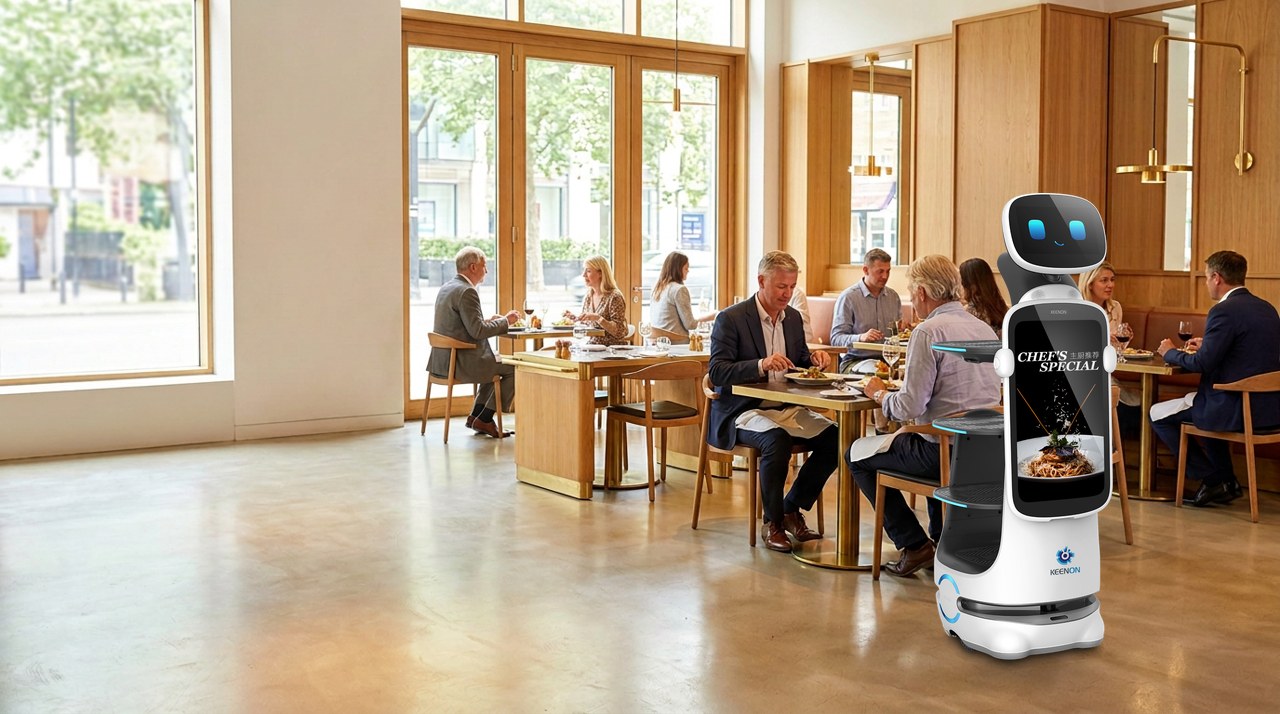
| DINERBOT T10 | Four trays; up to 40 kg total capacity; display screen | Meal and drinks rounds, with the screen available for the day's menu, activities or a welcome message in a lounge |
Capacity is not the same as a recommended load for every route. Staff should distribute items safely, respect tray limits and check the specific configuration during a site survey. The T10's display can provide useful information, but it does not change the division of work: the robot transports; staff support residents.
How a meal round could work
A practical meal round might look like this:
- Kitchen staff load the robot. Trays are organised for the destination and checked by staff. Food identification, allergens and temperature checks remain human responsibilities.
- The robot travels to an agreed handover point. This could be a lounge or a suitable corridor station, subject to the route assessment.
- Carers serve residents. Staff identify the right meal, assist residents as needed and provide the personal interaction that a robot cannot.
- The robot returns with used trays. Staff clear and unload it, then prepare it for its next assigned trip.
Between meals, a separate drinks or hydration round may be possible if it fits the home's routine. Linen and other supplies should be handled as separate runs, not mixed with food. The home should agree appropriate containers, cleaning and changeover procedures before using a robot for different types of load.

Helping residents and families feel comfortable
A robot may be new to residents and visitors. A brief, calm explanation can set expectations:
"This robot helps us move the trays. Your care team will still serve you and help with anything you need."
Staff should remain present at handover, answer questions and offer assistance as usual. No resident should be expected to approach, operate or unload the robot independently without an individual assessment. If a resident is unsure or distressed, staff should take over and follow the home's normal approach.
What to check before deployment
A robot may work well in one part of a home and be unsuitable for another route. Check the real environment, including how it changes at busy times.
- Measure corridors, doorways and turning areas. Check the narrowest points and passing places, not just the building plan.
- Assess floors and thresholds. Review carpets, floor transitions, ramps and any uneven or wet areas along the proposed route.
- Observe resident traffic. Consider wheelchairs, walking frames, beds, hoists, staff movements and furniture that may be moved during the day.
- Plan any lift use separately. Lift integration is not automatic or guaranteed. Compatibility, controls and installation requirements must be confirmed before planning a multi-floor route.
- Choose a suitable operating time. Consider noise, voice prompts and whether night-time use would disturb residents.
- Agree hygiene and load rules. Set cleaning procedures for trays and the robot, food-handling checks, and separate routines for food versus linen or supplies.
- Define supervision and fallback arrangements. Name who loads, who serves and who responds if a route is blocked or the robot stops. Keep a manual option available.
- Confirm privacy arrangements. Residents should not be recorded during mapping or normal operation. Confirm the system configuration and data handling before deployment.
A site survey is the right time to test routes and identify constraints. See what happens during a robot site survey and the healthcare and care-home robotics overview.
Start small, train the team and review the routine
A phased rollout helps staff and residents adapt. Start with one meal round to one lounge, ideally at a manageable time. Agree in advance who loads the trays, who receives them and who serves residents. Train the relevant staff on everyday operation, safe loading, cleaning, what to do if the robot stops and how to contact support.
Keep the existing manual method available while the team builds confidence. Review whether the route works in practice, whether residents are comfortable and whether the robot is genuinely helping the planned task. Expand only when the first routine is understood and working reliably.
Transport logs may help a home review when runs took place and support its own audit records or preparation of evidence for inspection. They do not demonstrate compliance by themselves, and a robot does not make a care home compliant.
Commercial options for robots for care homes
Fresh Mango Robotics offers three ways to deploy a robot:
- Outright purchase: the care home buys and owns the robot. Support can be arranged separately.
- Hybrid ownership: the care home owns the hardware and agrees an ongoing support and maintenance package.
- Robotics-as-a-Service (RaaS): the robot is provided through a subscription, avoiding upfront capital outlay. The agreed package includes maintenance, staff training and UK-based support.
The right option depends on the home's budget and support requirements. RaaS can be a way to begin with one robot and assess the workflow before considering a wider rollout. Any configuration and commercial terms should be set out in a written proposal. Read more about RaaS options or deploying a robot without buying it.
Fresh Mango Robotics supports deployment from site survey through installation, mapping and staff training, with ongoing support from a UK-based desk. See how the deployment process works.
Frequently asked questions
Do care home robots replace carers?
No. The T9 and T10 carry items along agreed routes. Carers remain responsible for serving residents, providing assistance and delivering care. The purpose is to support staff with transport, not replace them.
What can the Keenon T9 and T10 carry?
Both models have four trays and a total stated capacity of up to approximately 40 kg. They can support planned meal or drinks transport, subject to safe loading and the home's route assessment. Food checks and resident handover remain staff responsibilities.
Can a robot serve meals directly to residents?
The robot can bring trays to an agreed handover point. Staff should check the meals and serve residents, including providing any assistance required. A robot does not assess who should receive a meal or how it should be served.
Can the robot use lifts?
Possibly, but lift integration is a separate consideration. Compatibility and any required installation must be confirmed for the specific lift and robot; it should not be assumed.
Are care home delivery robots suitable for every home?
No. Corridor widths, thresholds, floors, resident traffic, lift access and operating routines all affect suitability. A site survey and trial on the intended route help establish whether the robot is appropriate.
How does Robotics-as-a-Service work for a care home?
RaaS provides a robot through a subscription rather than an upfront hardware purchase. The agreed service package includes maintenance, training and UK-based support. The exact configuration and terms are set out in a written proposal.
A practical way to give carers more time with residents
The T9 and T10 can help with a defined part of the care-home day: moving meal and drinks trays between locations. Success depends on a suitable route, clear staff responsibilities, careful hygiene and food checks, and resident-centred handover.
The principle remains straightforward: robots carry while your carers care. For a wider look at transport automation in care homes, read our overview of meal and linen transport.
Last reviewed:
Talk to a robot supplier you can actually visit
We are based in Ripon, North Yorkshire, with engineers across the North of England. On-site demos as standard.
Related articles
How Healthcare Robots are Solving the Meal and Linen Transport Crisis in UK Care Homes
UK care homes are using Keenon T-Series and W3 Butler robots to automate meal and linen transport, reduce staff burnout and recover their investment in 12-18 months.
What Happens in a Robot Site Survey? A Fresh Mango Engineer Walks You Through It
A Fresh Mango Robotics engineer explains how a real site is assessed for routes, floors, lifts, utilities, safety, installation and staff training.
RaaS, Not Capex: How UK Businesses Get a Commercial Robot Without Buying One
Robotics-as-a-Service turns a capital purchase into a predictable monthly operating cost, with site survey, installation, mapping, training, maintenance, software updates and UK-based support included.
Keep reading