UK humanoid robotics authority guide

Humanoid Robots for Business

Discover how the next generation of AI-powered humanoid robots are transforming hospitality, healthcare, retail and customer-facing industries.

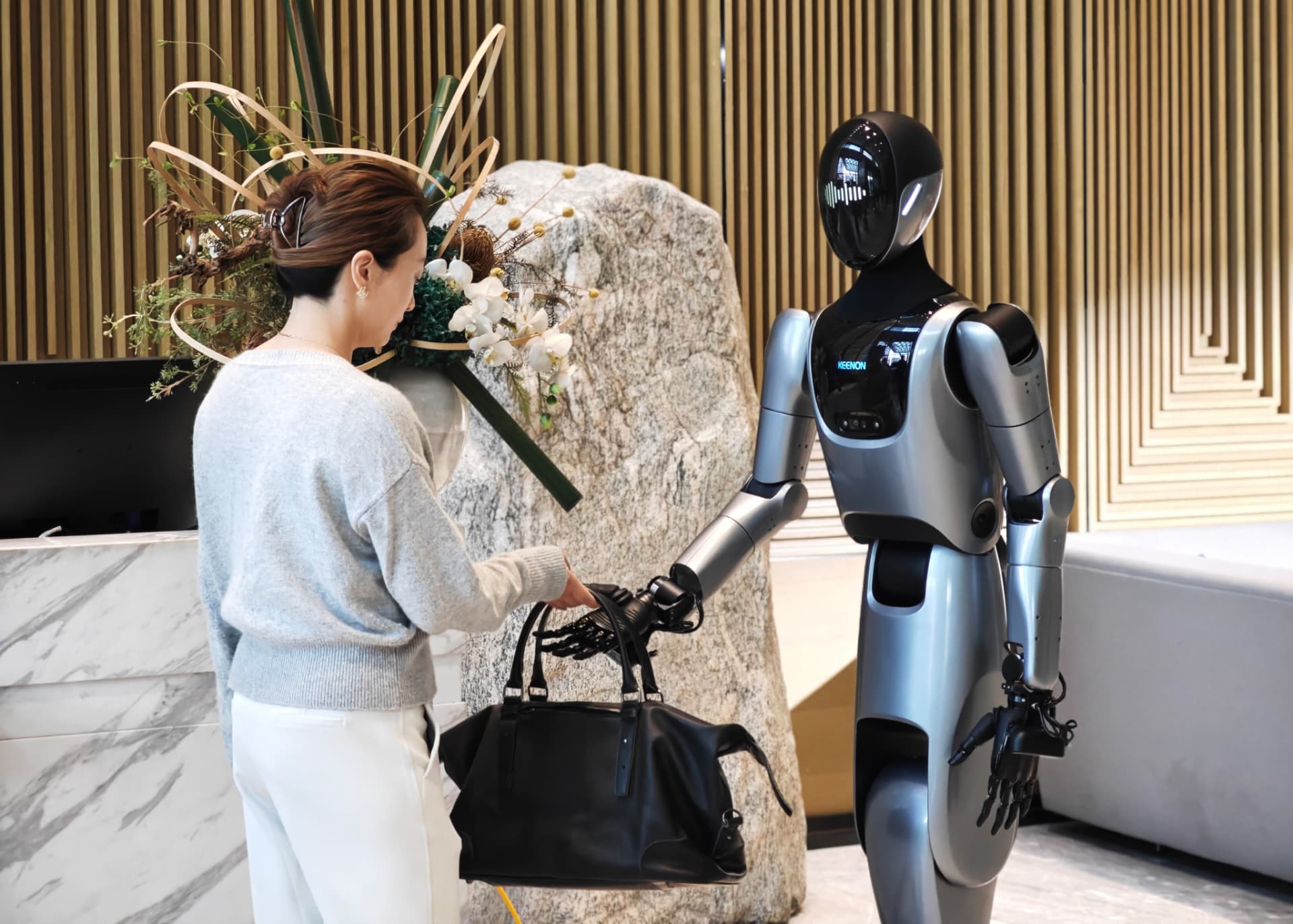
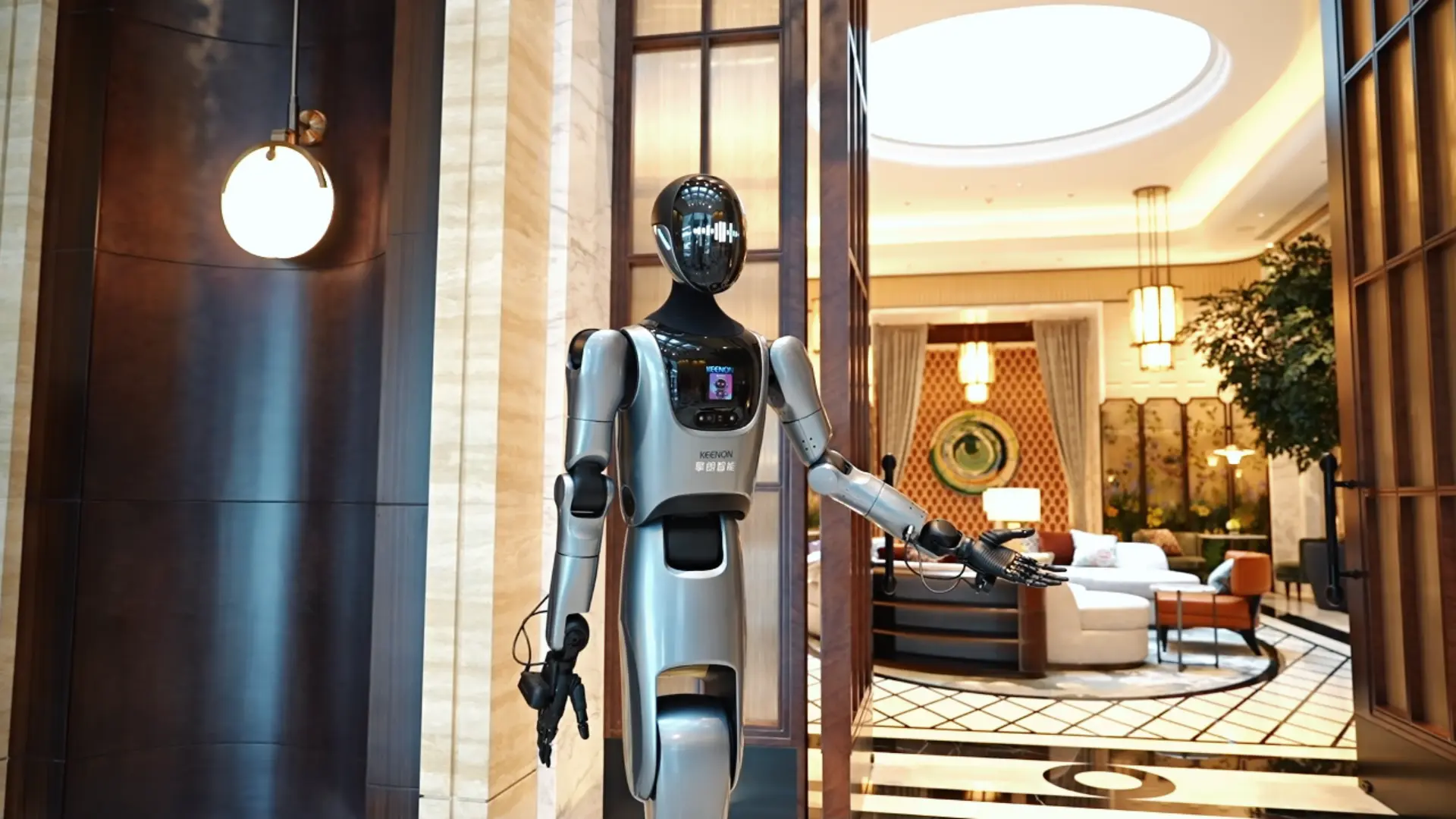
KEENON XMAN-R1 humanoid service robot greeting guests at a hotel lobby entrance

Direct answer

Humanoid robots are human-scale, AI-powered machines designed to work in spaces built for people and to interact face to face. In UK business settings they greet visitors, answer routine questions in natural spoken language, guide people to where they need to be and carry light items — supporting staff rather than replacing them. Adoption is led by hotels, hospitality groups, retail, healthcare support, visitor attractions, transport hubs and corporate reception.

Definition and context

What is a humanoid robot?

A humanoid robot is a machine built to roughly human shape and scale so that it can operate in environments designed for people and interact with them directly. Commercially available humanoids typically combine a human-height body, articulated arms, a wheeled base, cameras and safety sensors, and an AI system capable of natural spoken conversation. Their commercial purpose is interaction: being the first point of contact on a busy floor.

That distinction matters, because most robots already working in UK businesses are not humanoid. Food-running robots, room-service delivery robots, floor-cleaning robots and robotic beverage systems all do one job extremely well. A humanoid is deliberately general-purpose — it trades specialist throughput for the ability to hold a conversation, move around a building and adapt to whatever a visitor asks next.

How humanoid robots differ from other automation

Humanoid robots vs delivery robots

A delivery robot is a transport machine. It carries trays, meals, linen, medication or stock from A to B, usually on a fixed set of routes, and it is judged on how many runs it completes. A humanoid robot is an interaction machine: its value is in greeting, answering, guiding and handing over. Most humanoids can carry a light item, but that is a by-product of interaction rather than the purpose. In practice the two are complementary — a humanoid at the front of house and delivery robots working behind it.

Humanoid robots vs robotic arms

A robotic arm is fixed in place and repeats a defined motion with high precision — dispensing coffee, plating, packing, welding. It is excellent at one task in one location and does not move around the building or converse. A humanoid robot is mobile, general-purpose and conversational, and is far less precise than an industrial arm. Choose an arm when the job is a repeatable physical process at a station; choose a humanoid when the job is meeting people across a floor.

Humanoid robots vs self-service kiosks

A kiosk is a screen bolted to a spot. It works well when visitors already know what they want and are willing to queue and tap. A humanoid robot approaches people, speaks in natural language, handles vague or unusual questions, switches language on request and can physically escort someone to where they need to be. Kiosks are cheaper and appropriate for transactional flows; humanoids address the cases where visitors hesitate, get lost or need reassurance.

Humanoid robots vs voice assistants and chatbots

A chatbot or smart speaker answers questions but has no physical presence, cannot read a room and cannot lead anyone anywhere. Physical presence changes behaviour: people approach a robot that is visibly there, and a robot can notice that someone is waiting. The underlying AI is often similar; the difference is embodiment.

Why businesses are investing in humanoid robotics

The commercial logic is rarely novelty. UK operators investigating humanoids are usually dealing with a combination of the same pressures: customer-facing roles that are hard to fill and hold, rising employment costs, service quality that varies by shift, multilingual visitors on every shift, and boards asking what the organisation is doing about AI. A humanoid addresses all four at once — it holds a consistent routine baseline, works the hours that are hardest to cover, speaks several languages, and is visible proof of investment.

There is a second, quieter reason. Organisations that deploy now build internal capability: the content ownership, supervision habits and integration groundwork that later, more capable machines will need. That capability is harder to buy later than the robot itself. The strongest business cases we see pair a humanoid at the front of house with specialist service robots behind it, funded through Robot-as-a-Service so the cost sits alongside the labour cost it supports.

What humanoid robots can do today

  • Natural spoken conversation in multiple languages, including follow-up questions rather than fixed menus
  • Autonomous indoor navigation around people, furniture, queues and changing layouts
  • Greeting, wayfinding and physically escorting visitors to a lift, desk, room, ward or aisle
  • Answering routine, repeatable questions about opening times, facilities, menus, stock location and events
  • Carrying light items — a welcome pack, a menu, a sample, a small order — as part of an interaction
  • Displaying information, promotions, forms or QR codes on an onboard screen while talking
  • Escalating to a human when a request falls outside what it can handle
  • Logging interaction data: what people ask, when, where and in which language

Current limitations to plan around

  • Heavy lifting, ladders, stairs and outdoor or uneven ground are outside the scope of current commercial humanoids
  • Fine manipulation — making a bed, plating a dish, dressing a wound — remains a human task
  • Judgement, empathy, complaint recovery and safeguarding decisions must stay with trained staff
  • Very noisy environments can degrade speech recognition, so microphone position and floor layout matter
  • Battery life means planned charging windows; robots are scheduled around service peaks, not run continuously
  • Lift integration, door access and Wi-Fi coverage usually need site work before deployment
  • Content is only as good as the information it is given; someone must own and update what the robot says

Emerging developments

  • Vision-language-action models trained on service data rather than laboratory tasks, so robots infer the steps in a request instead of following a script
  • Better whole-body dexterity, widening the range of light physical tasks a humanoid can usefully complete
  • Fleet orchestration: humanoids co-ordinating with delivery, transport and cleaning robots through one management layer
  • Deeper systems integration with property management, EPOS, CRM, ticketing and building systems
  • Falling total cost of ownership, helped by Robot-as-a-Service models that remove the capital barrier
  • Emerging safety and assurance standards for robots operating in public spaces

How they work

How humanoid robots work — in business terms

Seven building blocks, each with a practical consequence for how your site runs. The engineering only matters because of what it lets your team stop doing.

Artificial intelligence

Large multimodal models let the robot understand what someone is asking in ordinary language, decide which action follows and explain itself. Commercially, this is what removes the need to train visitors on how to use the machine — they simply ask.

Machine vision

Cameras let the robot recognise people, obstacles, signage and its own position in the building. The business outcome is a robot that notices a waiting visitor and behaves predictably in a busy foyer.

Sensors

Laser scanners, depth sensors and bumpers give a continuous safety picture in every direction. This is what makes operation on a public floor acceptable to insurers, health and safety leads and your own team.

Navigation

The robot builds a map of your site during commissioning, then routes itself around it, re-planning when a route is blocked. No floor markings, rails or manual steering are required.

Voice interaction

Microphone arrays and text-to-speech create a two-way conversation, in the languages your visitors actually use. For international sites this is often the single biggest service gain.

Task execution

Requests become sequences: greet, answer, fetch, escort, hand over, return to station. Tasks are configured to your operation, so the robot does your version of the job rather than a generic demo.

Human-robot collaboration

The robot holds a routine baseline and escalates anything unusual to a person. Staff keep the judgement work; the robot absorbs repetition. Getting this handover right is the difference between a useful deployment and an expensive novelty.

Industries

Industries using humanoid robots

For each environment: the typical challenges, how a humanoid helps, the tasks it performs and the benefits to expect. Sector detail continues on our hospitality robotics, healthcare robotics and retail robots pages.

Hospitality

Typical challenges
Recruitment and retention pressure, unpredictable peaks, inconsistent service between shifts and rising wage costs.
How humanoid robots help
A humanoid holds the routine front-of-house baseline — greeting, waiting-list management, answering the same twenty questions — so the team can concentrate on hosting and upselling.
Typical tasks performed
  • Greet arrivals and manage the waiting list
  • Explain menus, allergens policy and opening hours
  • Guide guests to tables, cloakrooms or facilities
  • Promote events and offers on the onboard screen
Potential benefits
More consistent welcome, shorter perceived waits, fewer interruptions to service staff and a visible point of difference in a crowded market.

Hotels

Typical challenges
Thin overnight cover, front-desk queues at check-in and check-out, and multilingual guests arriving around the clock.
How humanoid robots help
The robot works the lobby alongside reception, answering routine enquiries and escorting guests, and remains available through the quiet hours when one person is covering the desk.
Typical tasks performed
  • Welcome guests and direct them to check-in
  • Answer questions on breakfast, spa, parking and Wi-Fi
  • Escort guests towards lifts and function rooms
  • Hand over welcome packs and light items
Potential benefits
Reception freed for check-in and problem-solving, better out-of-hours service, stronger multilingual coverage and measurable guest-feedback and review impact.

Retail

Typical challenges
Fewer colleagues on larger floors, customers unable to locate products, and abandoned baskets where no one was available to ask.
How humanoid robots help
A mobile humanoid answers 'where is…' at the point of hesitation and walks the customer to the aisle, rather than waiting for them to find a kiosk or a colleague.
Typical tasks performed
  • Answer product location and availability questions
  • Escort customers to a department or fitting room
  • Explain promotions, loyalty schemes and returns policy
  • Collect footfall and enquiry data by zone and hour
Potential benefits
Fewer lost sales from unanswered questions, colleagues kept on higher-value tasks, and hard data on what shoppers ask and where.

Healthcare

Typical challenges
Clinical time consumed by directions and administration, anxious visitors, and reception areas that are busy in bursts.
How humanoid robots help
The robot handles non-clinical reception and wayfinding work so clinical and administrative staff stay on patient-facing duties. Clinical care and triage always remain with people.
Typical tasks performed
  • Greet patients and visitors and direct them to departments
  • Explain visiting hours, parking and appointment check-in
  • Escort visitors along long corridors to the correct wing
  • Carry light, non-clinical items between reception points
Potential benefits
Fewer late or lost patients, less time lost to directions, calmer waiting areas and better multilingual access.

Care homes

Typical challenges
Staffing pressure, residents who benefit from frequent engagement, and family visitors needing orientation.
How humanoid robots help
Used carefully and with staff oversight, a humanoid supports activity programmes, reminders and visitor welcome — it does not deliver personal care.
Typical tasks performed
  • Welcome and orient family visitors
  • Support quizzes, music and group activity sessions
  • Deliver spoken reminders about mealtimes and activities
  • Carry light items between communal areas
Potential benefits
More engagement moments across the day, care staff protected for personal care, and a talking point that families and inspectors notice.

Corporate reception areas

Typical challenges
Single-person reception desks, visitor sign-in bottlenecks, contractor management and multi-site cover on one budget.
How humanoid robots help
The robot handles routine visitor greeting, sign-in prompts and wayfinding, with reception intervening only where judgement is needed.
Typical tasks performed
  • Greet visitors and prompt sign-in or badge collection
  • Notify hosts and direct guests to meeting rooms
  • Answer facilities questions and site rules
  • Escort visitors to lifts and waiting areas
Potential benefits
Consistent brand-standard welcome across sites, shorter visitor waits, and reception time redirected to hosting and security duties.

Events and exhibitions

Typical challenges
Short, intense footfall peaks, temporary staffing, and stands competing hard for attention and qualified leads.
How humanoid robots help
A humanoid draws a crowd, holds the opening conversation and captures interest, then hands warm visitors to the team on the stand.
Typical tasks performed
  • Attract and greet visitors to a stand or entrance
  • Deliver a consistent introductory pitch on request
  • Answer common questions and direct people to sessions
  • Capture enquiries and hand over to human staff
Potential benefits
Higher dwell time and stand traffic, consistent messaging regardless of who is on duty, and content that travels on social media and in press coverage.

Universities and education

Typical challenges
Enrolment and open-day surges, sprawling campuses, international students arriving with language needs, and stretched student services.
How humanoid robots help
The robot handles high-volume repeat questions and campus wayfinding at peak points in the academic calendar, and doubles as a live teaching and research asset.
Typical tasks performed
  • Answer enrolment, timetable and building questions
  • Guide visitors and students across campus buildings
  • Support open days, tours and recruitment events
  • Provide a working platform for robotics and AI teaching
Potential benefits
Shorter queues at peak weeks, better first-week experience for international students, and demonstrable investment in applied technology.

Museums and visitor attractions

Typical challenges
Volunteer-dependent staffing, varying group sizes, multilingual audiences and pressure to keep the offer fresh.
How humanoid robots help
A humanoid delivers repeatable interpretation and orientation content in several languages, freeing guides and volunteers for depth and hosting.
Typical tasks performed
  • Welcome visitors and explain the route and facilities
  • Deliver short interpretation talks in multiple languages
  • Answer questions about exhibits, times and accessibility
  • Direct visitors to cafés, shops and toilets
Potential benefits
Consistent visitor orientation, wider language coverage, an exhibit in its own right and stronger secondary spend from better wayfinding.

Leisure venues

Typical challenges
Weekend and holiday peaks, seasonal staff turnover and mixed audiences of families, groups and members.
How humanoid robots help
The robot covers entry-point questions and orientation during peaks, and entertains queues rather than leaving them idle.
Typical tasks performed
  • Greet arrivals and explain entry, sessions and safety rules
  • Direct visitors to activities, changing rooms and cafés
  • Promote memberships, offers and upcoming events
  • Entertain and inform queues at busy times
Potential benefits
Better peak-time flow, fewer repetitive questions at the desk, and a differentiator families remember and share.

Transport hubs

Typical challenges
Large volumes of unfamiliar, time-pressured travellers, complex layouts and multilingual demand around the clock.
How humanoid robots help
A mobile humanoid meets travellers where they hesitate, answers directional questions and escorts those who need help, in the language they ask in.
Typical tasks performed
  • Answer platform, gate, terminal and facilities questions
  • Escort travellers towards the correct area
  • Explain ticketing, luggage and accessibility options
  • Provide multilingual assistance during disruption
Potential benefits
Fewer missed connections, reduced pressure on information desks, better assisted-travel coverage and useful data on where travellers get lost.

Business benefits

What organisations gain from humanoid robots

Ten benefits worth writing into a business case — and worth measuring after deployment. Our benefits of commercial robotics page covers how to quantify them.

Improved guest experience

Someone is always available to answer the first question. Visitors are met, oriented and reassured instead of queuing or wandering, which is what most negative feedback is actually about.

Enhanced service consistency

The robot delivers the same welcome and the same information at 7am on a Tuesday as at 9pm on a Saturday, regardless of who is on shift or how new they are.

Operational efficiency

Repetitive questions, directions and light errands are absorbed by the robot, returning hours to the team for hosting, selling and problem-solving.

Extended service availability

Early mornings, late evenings, weekends and thin overnight cover are where service quality slips. A robot holds a baseline through those windows.

Brand differentiation

A humanoid on the floor is noticed, photographed and talked about. It is one of the few operational investments that also markets the venue it works in.

Data and insights

Every interaction is a data point: what people ask, when, where, in which language. That evidence informs signage, staffing, stock placement and training.

Scalability

A configuration proven at one site can be rolled out to the next with the same content, tasks and reporting. Multi-site groups get a repeatable standard rather than local improvisation.

Innovation leadership

Boards, funders, inspectors and prospective staff all read visible automation as evidence of an organisation investing in its future.

Labour support

Where roles are genuinely hard to fill, a robot keeps the service standard intact rather than leaving gaps that customers feel.

Future workforce augmentation

Teams that learn to work with robots now build the supervision and content skills that later deployments depend on — a capability advantage, not just a machine.

A balanced view

Are humanoid robots replacing staff?

In the deployments we work on, no. Humanoid robots are used to support teams, not substitute for them, and the reason is practical rather than diplomatic: the tasks a humanoid does well are the narrow, repetitive parts of a customer-facing role, while the parts that keep customers loyal — reading a mood, resolving a complaint, exercising judgement, handling a safeguarding or dietary concern — are exactly the parts a robot cannot do.

What changes is the shape of the role rather than the headcount. Staff spend less time repeating directions and opening times, and more time hosting, selling and solving problems. New responsibilities appear too: someone has to own what the robot says, supervise it during service and check its reporting.

What humanoid robots are most commonly used for

  • Supporting teams during peaks, sickness, holidays and rota gaps
  • Automating repetitive tasks — directions, routine questions, light errands
  • Freeing staff for higher-value work such as hosting, selling and service recovery
  • Improving the customer experience by making sure someone is always available to ask

We do not make claims about wider labour-market effects, and we would treat any supplier who does with caution. What we can say is what we see on site: robots covering hours that were previously uncovered, and teams doing more of the work they were hired for.

Why Fresh Mango Robotics

Why organisations plan humanoid deployments with us

Buying the machine is the easy part. What decides whether it works is site planning, content, training and support.

UK deployment expertise

We plan, commission and support robots on real UK sites — listed buildings, tight kitchens, narrow corridors, mixed flooring and lifts that were never designed with robots in mind.

Demonstrations and consultancy

See a robot working before you commit. Our consultations map which tasks are worth automating first, and say plainly when a humanoid is not the right first investment.

Training

We train your team to run, supervise and update the robot, including what to do when a visitor asks something it cannot handle. Adoption depends on staff confidence.

Ongoing support

One UK support desk for the whole estate, with software updates, content changes, spares and remote diagnostics.

Robot-as-a-Service options

Buy, finance or run on a monthly Robot-as-a-Service agreement so the cost sits in operating budget alongside the labour cost it supports.

Multi-vendor advice

We are not tied to one machine. Where a delivery robot, cleaning robot or robotic arm would pay back faster than a humanoid, that is the advice you will get.

Integration assistance

Lifts, doors, Wi-Fi, EPOS, property management and visitor systems. We handle the site work that decides whether a deployment actually works day to day.

Outlook

The future of humanoid robots

Advances in AI

The step change of the last two years has not been mechanical. It has been the arrival of vision-language-action models that let a robot connect what it hears to what it sees and then to what it should do. Earlier interaction robots followed decision trees, which is why they failed the moment a visitor phrased something unexpectedly. Models trained on service data handle the messy middle: half-finished sentences, accents, follow-up questions, requests that combine two things at once. Expect that competence to keep improving faster than the hardware around it.

Increased autonomy

Autonomy is widening in two directions. Physically, better manipulation is bringing more light handling tasks into range — presenting items, operating simple equipment, tidying a surface. Operationally, robots are becoming better at recovering from the unexpected: a blocked route, a busy lift, a request they cannot complete. The commercial marker to watch is not whether a robot can perform a task in a demonstration, but whether it can be left to run a shift with light supervision.

Business adoption trends

Adoption is following a recognisable pattern. Task-specific robots go in first, usually food-running or floor cleaning, because payback is easy to model. Once a team is comfortable working alongside a machine, attention moves to the customer-facing gap — the reception desk, the lobby, the entrance during peaks — and that is where humanoids enter. Hospitality, retail, healthcare support, transport hubs and visitor attractions are furthest ahead in the UK. Pilots are typically single site and single area, then scale once content ownership and supervision are proven.

Multi-robot collaboration

The interesting near-term development is fleets rather than individual machines. A humanoid takes a request at the door and passes the physical work to a delivery robot; a cleaning robot is told to avoid a room until a function ends; all three report into one management layer that a duty manager can read on a phone. This is where operational value compounds, and it is a strong argument for keeping an estate on compatible platforms and one support relationship instead of buying machine by machine.

Service industry transformation

The likely destination is not robot-run venues. It is a division of labour that looks obvious in hindsight: machines absorb the repetitive, predictable and physically dull elements of service, and people concentrate on hospitality, judgement and relationships. The organisations that benefit most will be those that treated their first deployment as a capability-building exercise — writing the content, training the supervisors, agreeing the measures — rather than as the purchase of a talking point.

Humanoid Robots at a Glance

What humanoid robots are
Humanoid robots are human-scale, AI-powered machines built to work in spaces designed for people. Commercial models combine a human-height body, articulated arms, a wheeled base, cameras and safety sensors with AI that understands natural spoken language. The KEENON XMAN-R1 is one example available in the UK through Fresh Mango Robotics.
Who uses them
Hotels, hospitality groups, restaurants, retail operators, hospitals and private clinics, care homes, corporate facilities teams, visitor attractions, museums, universities, event organisers and transport operators.
Typical tasks
Greeting visitors, answering routine questions in several languages, wayfinding and escorting, presenting information on an onboard screen, carrying light items, capturing enquiry data and escalating unusual requests to staff.
Benefits
Consistent service across every shift, cover during peaks and thin hours, staff time returned to higher-value work, multilingual support, interaction data, brand differentiation and a repeatable standard across multiple sites.
Industries
Hospitality, hotels, retail, healthcare, care, corporate facilities, events and exhibitions, education, museums and visitor attractions, leisure, and transport hubs.
Adoption trends
UK adoption is early but accelerating. Operators generally start with task-specific delivery or cleaning robots, then add a humanoid in customer-facing areas. Robot-as-a-Service agreements are the most common route because they remove the upfront capital cost. Humanoids are deployed to support staff, not to replace them.

Frequently asked questions

Humanoid robots: 30 questions answered

What is a humanoid robot?

A humanoid robot is a machine built to roughly human shape and scale so it can work in spaces designed for people and interact face to face. Commercial humanoids typically combine a human-height body, articulated arms, a wheeled or legged base, AI-powered speech, cameras and safety sensors. In business settings they are used for interaction — greeting, informing, guiding and handing over — rather than heavy physical work.

What can humanoid robots do?

Current commercial humanoid robots hold natural spoken conversations in multiple languages, navigate indoor spaces autonomously, greet and escort visitors, answer routine questions, carry light items, display information on an onboard screen, log interaction data and escalate anything unusual to a member of staff.

How much does a humanoid robot cost?

Commercial humanoid service robots are a significantly larger investment than task-specific delivery or cleaning robots, and pricing depends on configuration, content set-up, integration and support level. Many UK organisations avoid the capital cost by using a monthly Robot-as-a-Service agreement. Contact Fresh Mango Robotics for current UK pricing, lead times and finance options for a specific model.

Can humanoid robots work in hotels?

Yes. Hotels are one of the most active use cases. A humanoid works the lobby alongside reception, greeting guests, answering questions about breakfast, parking, spa and Wi-Fi, escorting guests towards lifts and function rooms, and holding a service baseline through quiet overnight hours when one person covers the desk.

Are humanoid robots available in the UK?

Yes. Commercial humanoid service robots can be supplied, installed and supported in the UK. The practical constraints are lead times, site readiness — Wi-Fi, lift access, flooring — and having someone who owns the content the robot delivers. Fresh Mango Robotics supplies, commissions and supports humanoid robots across the UK.

Can humanoid robots interact with customers?

Yes, and that is their main purpose. Modern humanoids use large multimodal AI models to understand ordinary spoken language, so customers ask for what they want in their own words instead of navigating a touchscreen menu. Many support several languages and switch on request.

Can humanoid robots work alongside employees?

Yes. In almost every commercial deployment the robot handles a routine baseline and escalates anything unusual to a person. Successful projects define that handover explicitly: which questions the robot answers, which it passes on, and who supervises it on each shift.

What are the benefits of humanoid robots in hospitality?

The main benefits are a consistent welcome regardless of shift, cover during peaks and thin hours, fewer interruptions to service staff, multilingual support, richer data on what guests ask, and visible differentiation that guests photograph and share.

Are humanoid robots suitable for healthcare?

They are suitable for non-clinical work: greeting patients and visitors, wayfinding along long corridors, explaining visiting hours and parking, and carrying light non-clinical items. Clinical assessment, treatment and personal care remain with qualified staff. Infection control, accessibility and information governance must be agreed before deployment.

How are humanoid robots powered?

Commercial humanoids run on rechargeable lithium battery packs and return to a docking station to charge. Operating time per charge varies by model and workload, so deployments are scheduled around service peaks with planned charging windows rather than assuming continuous running.

How do humanoid robots differ from delivery robots?

Delivery robots are transport machines optimised for moving items along repeated routes. Humanoid robots are interaction machines optimised for meeting and helping people. Many sites run both: a humanoid at the front of house and delivery robots working behind it.

How do humanoid robots differ from self-service kiosks?

A kiosk is fixed and waits to be used. A humanoid moves to where people are, speaks rather than requiring taps, handles vague or unusual questions and can physically escort someone. Kiosks remain cheaper and better for purely transactional flows.

Do humanoid robots need Wi-Fi?

Yes. Reliable Wi-Fi coverage across the working area is required for AI interaction, updates, fleet management and reporting. Surveying and, where needed, improving coverage is a normal part of commissioning.

Are humanoid robots safe around the public?

Commercial humanoids are designed for shared public space, using laser scanners, depth sensors and cameras to detect people and obstacles, and moving at walking pace with predictable stopping behaviour. Deployments should still include a site risk assessment, defined operating zones and staff supervision.

How long does it take to deploy a humanoid robot?

Once a machine is on site, mapping and commissioning typically take days rather than weeks. The realistic timeline is driven by lead time, site readiness — Wi-Fi, lift integration, charging point — and the time your team needs to write and approve the content the robot delivers.

Can a humanoid robot speak more than one language?

Yes. Multilingual interaction is one of the strongest commercial arguments for humanoids in hotels, airports, attractions and universities, where multilingual staffing on every shift is impractical.

Can humanoid robots be branded for our business?

Yes. Greeting scripts, screen content, tone of voice, promotions and often physical branding elements can be configured to your brand standards, and updated centrally across multiple sites.

Do humanoid robots integrate with existing business systems?

Integration with property management, EPOS, ticketing, visitor management and building systems is increasingly common and is scoped project by project. Assume integration work is part of the deployment rather than an afterthought.

What maintenance do humanoid robots need?

Routine cleaning and sensor checks by your team, plus scheduled preventative maintenance, software updates and occasional part replacement by the supplier. Support and maintenance should be contracted from day one, not arranged after the first fault.

What happens when a humanoid robot cannot answer a question?

It should say so and escalate. Well-configured robots hand over to a named role or alert a member of staff rather than guessing. That escalation path is part of the configuration and should be tested during commissioning.

Can humanoid robots work outdoors?

Current commercial humanoid service robots are indoor machines. Weather, uneven ground, kerbs and steps are outside their operating envelope. Outdoor tasks need different classes of robot.

Can humanoid robots climb stairs?

Wheeled commercial humanoids cannot use stairs and rely on lifts or single-floor deployment. Bipedal humanoids that can manage steps exist but are largely at research and pilot stage rather than in routine commercial service.

How much can a humanoid robot carry?

Light items only — a welcome pack, menu, sample or small order. Where the requirement is trays, linen, medication rounds or stock, a purpose-built delivery or transport robot is the correct machine.

Do we need technical staff to run a humanoid robot?

No. Day-to-day operation is designed for ordinary staff: start, supervise, update content, dock for charging. You do need a named owner on site who is responsible for content accuracy and for reporting faults.

What is Robot-as-a-Service?

Robot-as-a-Service is a monthly agreement covering the robot, software, support and maintenance instead of an upfront purchase. It puts robotics in operating budget alongside the labour cost it supports, and makes it easier to scale or stop.

How do we measure return on investment from a humanoid robot?

Agree the measures before deployment. Common ones are staff hours returned from repetitive enquiries, queue and wait times at reception, guest satisfaction and review scores, secondary spend from better wayfinding, and coverage maintained during thin shifts.

Are humanoid robots suitable for small businesses?

Sometimes, but not usually as a first investment. A single-site operator normally gets faster payback from a task-specific delivery or cleaning robot. Humanoids make the strongest case where visitor volume, multilingual demand or brand differentiation is high.

What data do humanoid robots collect?

Typically interaction and operational data: questions asked, languages used, routes travelled, times and locations, and fault logs. Where cameras or any personal data are involved, agree retention, access and UK GDPR compliance in writing before going live.

How quickly is business adoption of humanoid robots growing?

Adoption is early but accelerating, led by hospitality, retail, healthcare support, transport hubs and visitor attractions. The pattern to date is small pilots in customer-facing areas, followed by wider rollout once staff supervision and content ownership are proven.

Can we see a humanoid robot before buying?

Yes. Book a demonstration to see a robot working in a realistic setting, or arrange a robotics consultation to map which robots suit which parts of your operation before you spend anything.

Enquire

Investigating humanoid robots for your organisation?

Tell us about the environment and the tasks you are trying to cover. We will tell you honestly whether a humanoid is the right first step — and what would pay back faster if it is not.

What can we help with?

We respond within one UK business day. We never share your details.

Continue reading

Related pages