
Are Restaurant Robots Worth It? A 2026 ROI Guide
A practical 2026 walk-through of where restaurant robots earn their keep, the venues they suit, and where the payback actually comes from.
Quick answer
Most UK restaurants with 120+ covers per service and meaningful kitchen-to-table runs see a Keenon DINERBOT pay back in 10–22 months. ROI comes from removing 60–80% of staff carrying miles, cutting agency and overtime on banquet service, and lifting spend per head by keeping servers at the table. Small, dense bistros under 60 covers rarely justify a restaurant robot.
Restaurant robots have moved out of novelty territory. UK groups are now buying them the same way they bought EPOS or card terminals fifteen years ago — because the numbers work. The question for 2026 is not whether they work; it is whether they work in your room.
Where the ROI actually comes from
It is rarely "the robot replaces a waiter." It is more useful to think of the robot as removing the heavy carrying and long runs from your team's shift, freeing them for guest-facing work that drives spend per head.
- Reduced steps per shift (we measure 60–80% fewer kitchen-to-table runs for floor staff)
- Faster table turns at peak — food arrives at the table while it is still hot
- Lower agency and overtime spend during banquet and event service
- Reduced spillage, fewer breakages, less staff strain
- Higher upsell rate: servers spend more minutes at the table
Payback periods we see in practice
- Banquet / large dining rooms (DINERBOT T9): 10–14 months
- Fine dining / hotels (DINERBOT T8): 14–22 months
- 150–300 cover large-format venues (DINERBOT T10): 14–22 months
- Small bistros under 60 covers: often does not pay back — be honest about this
Venues that suit a restaurant robot
- Long runs between kitchen and tables
- Multi-course service
- Large covers per shift (120+)
- Banquet, buffet or event-driven trading
- Persistent recruitment or retention difficulty
Venues that do not
Small, dense, low-cover-count rooms with tight aisles. We will tell you if that is you. We would rather lose the sale than deploy a robot that sits in a corner.
DINERBOT T8 vs T9 vs T10 — restaurant fit
| Model | Best-fit venue | Strength | Typical payback |
|---|---|---|---|
| DINERBOT T8 | Fine dining & hotel F&B | Compact footprint, premium presentation | 14–22 months |
| DINERBOT T9 | Banqueting & large dining rooms | High tray capacity, long-run service | 10–14 months |
| DINERBOT T10 | 150–300 cover large-format venues | Heavy throughput, multi-tier delivery | 14–22 months |
How a UK restaurant deployment runs in practice
Restaurant robot ROI only lands when deployment is taken seriously. A Fresh Mango Robotics deployment starts with a site survey — aisle widths, pass location, lift access, network coverage — followed by floor mapping using a tablet rather than a permanent installation. Table numbers are configured into the robot, exclusion zones are set around the host stand and bar, and route timing is tuned for the venue's service rhythm. Shift teams are trained on day-one operation before service. The robot is normally in live operation for that evening's covers. The first two weeks are a tuning window: routes, dwell times and call-back behaviour are refined from real operational data, not assumptions made on paper.
Frequently asked questions
Are restaurant robots worth it for a UK independent operator?
Yes, when the venue meets a few simple criteria: 120+ covers per service, meaningful kitchen-to-table runs, multi-course service or banquet/event trading, and recruitment or retention difficulty. Below that profile the case is usually marginal, and the right answer is to say so.
Which DINERBOT model suits a 200-cover restaurant?
For a 200-cover UK restaurant doing standard à-la-carte service, the DINERBOT T9 is usually the right pick — high tray capacity, suited to long runs between kitchen and floor. Fine-dining 200-cover venues with tighter aisles often pair better with the T8.
Where does restaurant robot ROI really come from?
Not from replacing a server. It comes from removing repetitive carrying so the floor team is in front of guests, reducing agency cover on peak nights, lowering overtime on banquet service and lifting measurable spend per head.
Do restaurant robots work in fine dining?
Yes — they are deployed in UK fine-dining hotel restaurants. The DINERBOT T8 is built for tighter, higher-presentation environments and runs at controlled speeds and low noise levels, with table-side interaction staying with the human team.
How long does it take to deploy a DINERBOT?
A typical UK restaurant deployment is mapped, configured and in live service within a single day — including floor mapping, table-number setup, exclusion zones at the bar and pass, and shift-team training.
Can two DINERBOT robots run in the same venue?
Yes. Larger UK venues commonly run two DINERBOT units in parallel during banquet service or peak nights. The robots coordinate route timing so they do not converge in narrow aisles.
Talk to a robot supplier you can actually visit
We are based in Ripon, North Yorkshire, with engineers across the North of England. On-site demos as standard.
Related articles
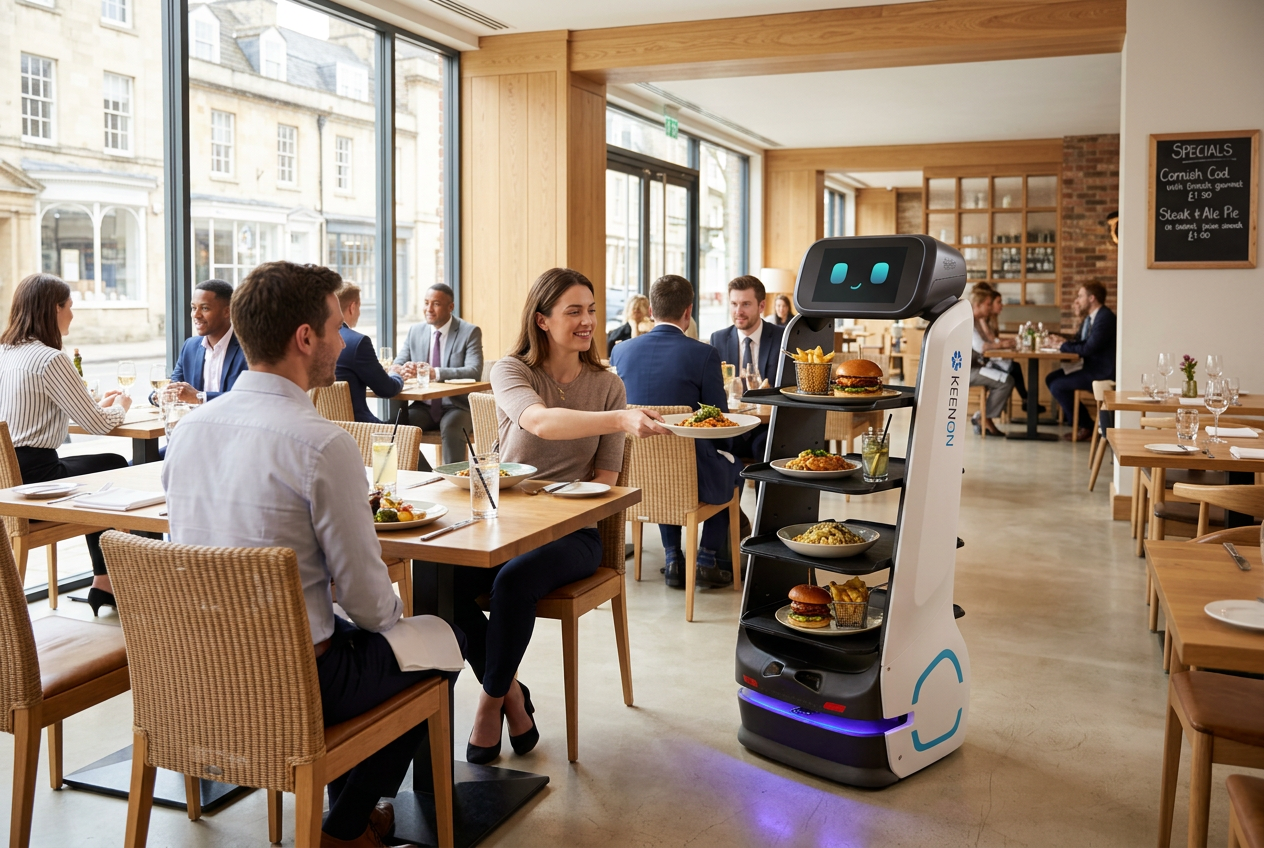
Service Robot vs Waiter: Where Does the ROI Come From?
An honest breakdown of where the ROI on a restaurant service robot actually comes from — and why "replacing a waiter" is the wrong framing.
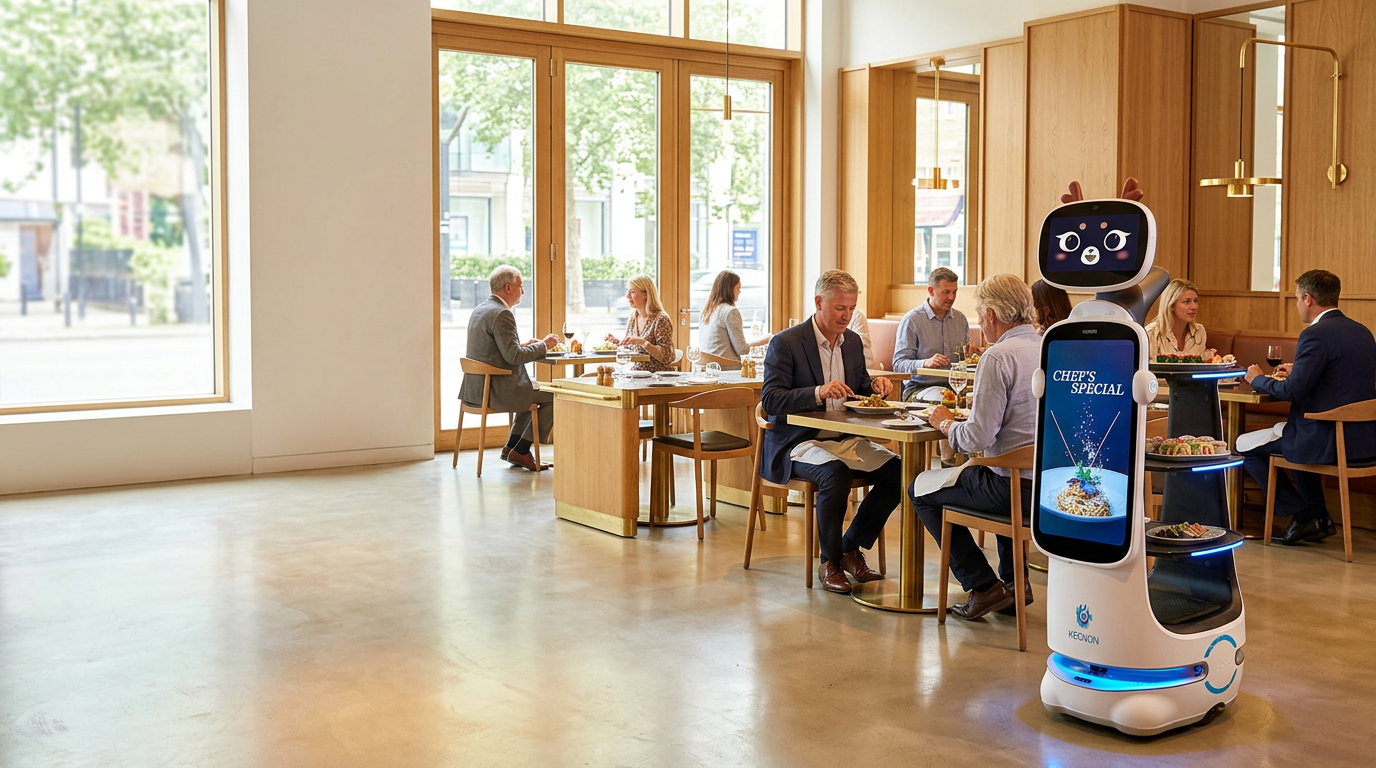
How Much Does a Commercial Service Robot Cost in the UK?
Category pricing bands, monthly rental and total cost of ownership for commercial service, cleaning and logistics robots in the UK.
How Much Labour Can a Delivery Robot Save?
By hours per shift, by full-time-equivalent and by annual pound figure — what a commercial delivery robot actually saves a UK operation in labour.
Keep reading