
How a Commercial Robot Deployment Works: From Demonstration to Go-Live
What actually happens between the first demo and the robot going live in your operation — the deployment process used by Fresh Mango Robotics across the UK.
Quick answer
A commercial robot deployment in the UK runs through seven stages: on-site demonstration, site survey, proof of concept, installation, floor mapping and configuration, staff training, and post-go-live optimisation under ongoing UK support. Most single-site service and delivery deployments complete inside a working day; cleaning and warehouse deployments typically complete within one to two weeks. The supplier — not the operator — owns the technical work.
The deployment process is where most of the operator anxiety on a first robot sits, and it should not be. Done properly, a commercial robot deployment is a well-rehearsed sequence — not a project. The work is owned by the supplier, the operator's team is involved at the right points, and the robot is in productive use very quickly. This is the deployment process Fresh Mango Robotics runs across the UK.
The seven stages of a UK robot deployment
| Stage | What happens | Who owns it | Typical duration |
|---|---|---|---|
| 1. On-site demonstration | Working robot brought to the operator's premises and run on the actual floor | Supplier | Half a day |
| 2. Site survey | Floor surfaces, doorway widths, lift compatibility, network coverage and route assessment | Supplier | 1–2 hours on site |
| 3. Proof of concept (if required) | Live trial period in the operator's environment to validate fit | Supplier, with operator sign-off | 1–4 weeks |
| 4. Installation | Hardware delivery, dock and charging setup, lift controllers fitted where required | Supplier | Half a day to one day |
| 5. Floor mapping & configuration | Robot map built, routes set, exclusion zones added, integrations configured | Supplier | 2–6 hours |
| 6. Staff training | Day-one operation, dispatch, manual override and basic exception handling | Supplier, with operator team | 1–2 hours per shift team |
| 7. Optimisation & support | Routes, dwell times and charging windows tuned from real operational data; ongoing UK support | Supplier, continuous | Continuous |
Stage 1 — On-site demonstration
The first commitment is a working demonstration on the operator's actual floor. A showroom demo proves nothing about the building it will live in. A Fresh Mango Robotics engineer brings the robot, sets it up against the real environment, and runs it through realistic routes — kitchen-to-table runs, lobby cleaning cycles, ward delivery runs, picking-to-packing transport. Operators see the robot interacting with their staff, furniture, doorways and lifts before any contract is signed.
Stage 2 — Site survey
The site survey is short but consequential. The engineer assesses floor surfaces, doorway widths, lift dimensions and control systems, network coverage, charging-point location, and any zones where the robot should be excluded. The output is a written scope — what the robot will do, what the operator needs to provide (typically just power and Wi-Fi coverage), and any building works required ahead of install. There should be no surprises after this stage.
Stage 3 — Proof of concept (where appropriate)
On larger or more complex deployments, particularly multi-site rollouts and warehouse internal-transport, a short proof of concept makes sense. The robot is installed for a defined trial period in the live environment, with operational data captured and reviewed jointly. This de-risks the wider rollout and gives the operator's finance team a real number to sign against, not a model.
Stage 4 — Installation
Installation is intentionally undramatic. Hardware is delivered, the charging dock is positioned and powered, lift controllers are fitted at the lift control panel where required, and any plumbing for auto-refill cleaning docks is connected. For most service and delivery deployments, installation is complete inside a working day. Warehouse and cleaning deployments with more infrastructure typically take one to two days.
Stage 5 — Floor mapping and configuration
The robot builds its map of the building using onboard LiDAR and 3D cameras as an engineer walks it through the operating area on a tablet. Routes are then configured (table numbers, ward numbers, picking zones), exclusion zones are added around the bar pass, host stand, pick faces or any other sensitive area, and integrations with lifts, POS or WMS are configured and tested with the operator's own data.
Stage 6 — Staff training
Robots fail in operations where staff were never properly trained. Day-one operation, dispatch, manual override, charging behaviour and basic exception handling are walked through with each shift team that will use the robot — including night and event shifts where applicable. Training is delivered on the actual robot, not in a classroom, and lasts one to two hours per team. A short on-call quick-reference is left with the operator.
Stage 7 — Optimisation and ongoing UK support
The first two weeks after go-live are a tuning window. Routes, dwell times, call-back behaviour and charging windows are adjusted from real operational data — not from assumptions made at deployment. After that, the robot enters steady-state operation. Ongoing UK support covers first-line telephone support during operating hours, remote diagnostics, scheduled preventive maintenance, software updates over the air, and on-site engineer attendance — typically inside 24–48 hours — for anything that cannot be resolved remotely.
What the operator's team is asked to do
- Provide site access for the demo, survey, install and training
- Confirm power and network coverage in the robot's operating area
- Identify the shift teams to be trained at go-live
- Sign off the mapped routes and exclusion zones
- Nominate a single point of contact for the deployment
Typical UK deployment timelines
| Deployment type | Typical UK timeline | Notes |
|---|---|---|
| Service / delivery robot (single site) | Inside one week | Often live the same week, in operation within a working day on site |
| Cleaning robot (single hotel or facility) | 1–2 weeks | Includes overnight cycle testing and refill / dock plumbing |
| Warehouse internal-transport (single site) | 1–2 weeks | Includes WMS integration, safety checks and shift training |
| Multi-site rollout | Phased to operator's go-live plan | Sites sequenced to avoid simultaneous disruption |
Why deployment is the deciding factor
Operators who have had a poor experience with a robot almost always had a poor experience with the deployment. The hardware is not usually the problem — the absence of a real site survey, proper mapping, structured training and UK support is. A well-run deployment is what turns a robot from a novelty into a piece of operational infrastructure.
Frequently asked questions
How long does a commercial robot deployment take in the UK?
Most single-site service and delivery robot deployments are live within one week of signed order, with on-site install, mapping and training completed in a working day. Cleaning and warehouse internal-transport deployments typically take one to two weeks once site survey, integration and shift training are included.
Does the operator have to install anything before deployment?
No major works are typically required. The operator provides power for the charging dock and Wi-Fi or 4G coverage in the robot's operating area. Lift controllers, plumbing for auto-refill cleaning docks and WMS integration are handled by Fresh Mango Robotics during install.
What is included in a Fresh Mango Robotics deployment?
On-site demonstration, site survey, installation, floor mapping, route and exclusion-zone configuration, integration with lifts, POS, kitchen display or WMS where required, staff training on day-one operation, and a post-go-live optimisation window. UK-based support continues for the contract term.
Is staff training included in a robot deployment?
Yes. Day-one operation, dispatch, manual override, charging behaviour and basic exception handling are walked through with each shift team that will use the robot — including night and event shifts where applicable — at no separate charge.
How is a robot's map of the building built?
An engineer walks the robot through the operating area on a tablet while the onboard LiDAR and 3D cameras build a software map. Routes, table numbers, ward numbers or picking zones are then configured on top of that map, along with exclusion zones around any sensitive areas.
What support is provided after go-live?
UK-based first-line telephone support during operating hours, remote diagnostics through the robot's onboard 4G or site Wi-Fi, scheduled preventive maintenance, software updates over the air, and on-site engineer attendance — typically inside 24–48 hours — for anything that cannot be resolved remotely.
What happens in the optimisation window after go-live?
Routes, dwell times, call-back behaviour and charging windows are adjusted from real operational data captured in the first two weeks of live operation. This tuning is included as standard — robots are not handed over on day one and forgotten.
Will a UK deployment be turned down if the robot is not the right fit?
Yes. A genuine deployment partner will tell the operator when a robot does not suit the site — too dense, unsuitable floor surface, insufficient labour offset to justify the cost. Walking away from a poor-fit deployment is the right answer for both sides.
Talk to a robot supplier you can actually visit
We are based in Ripon, North Yorkshire, with engineers across the North of England. On-site demos as standard.
Related articles
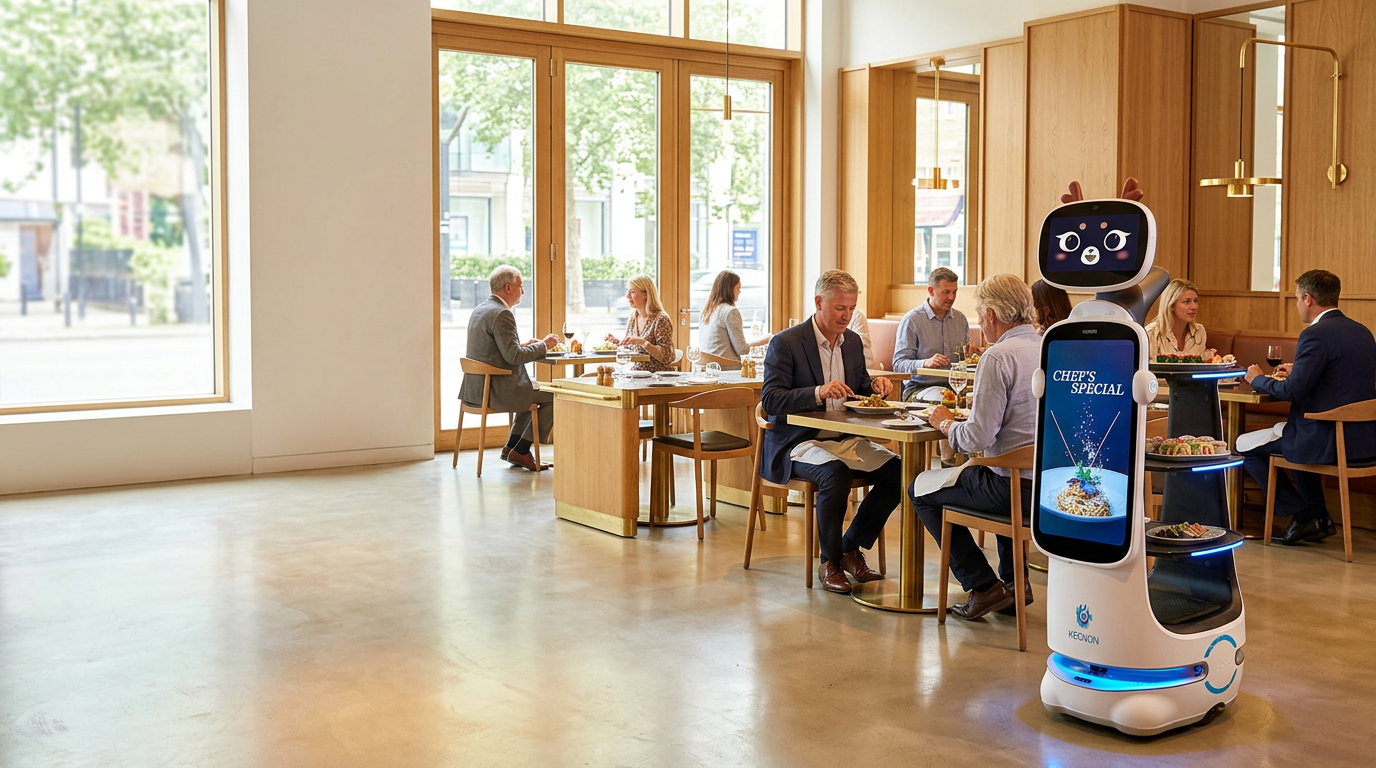
How Much Does a Commercial Service Robot Cost in the UK?
Category pricing bands, monthly rental and total cost of ownership for commercial service, cleaning and logistics robots in the UK.
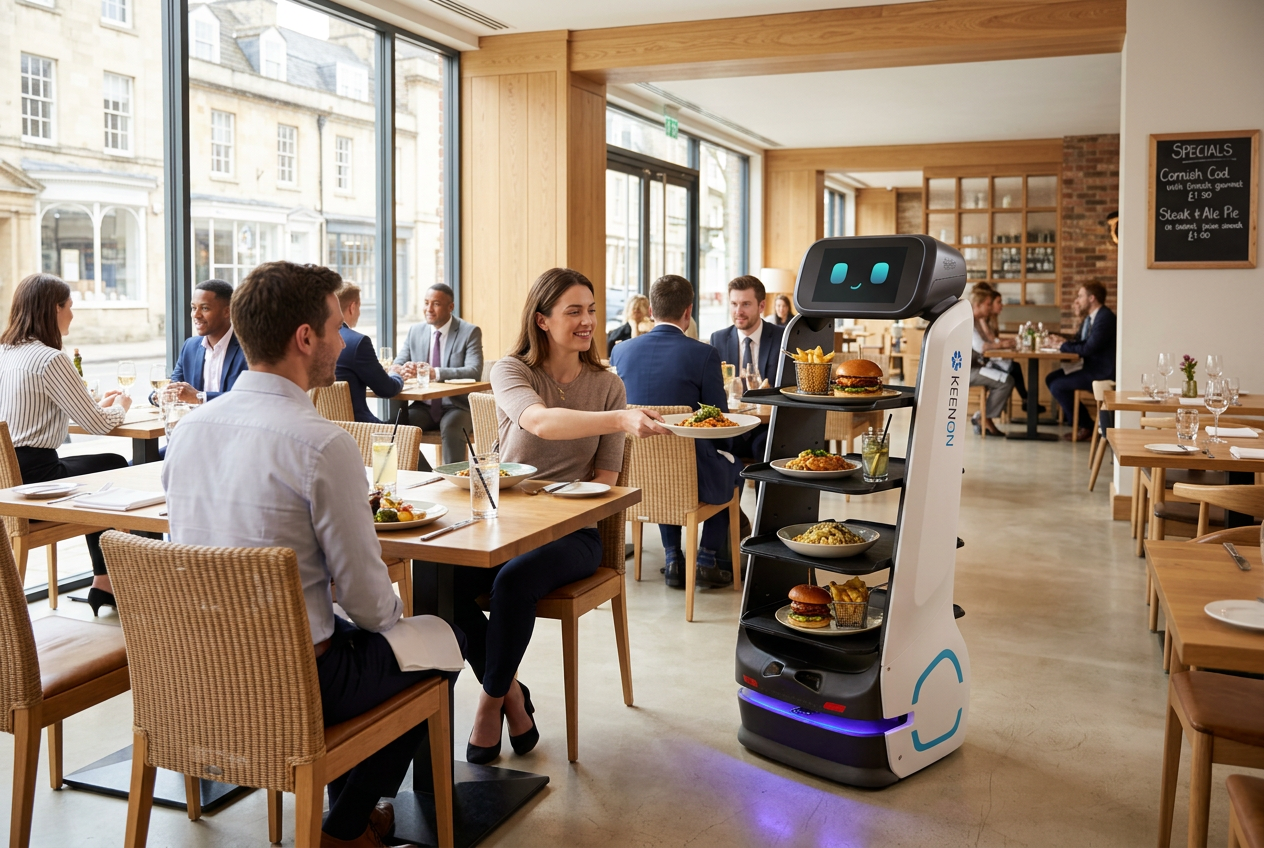
Service Robot vs Waiter: Where Does the ROI Come From?
An honest breakdown of where the ROI on a restaurant service robot actually comes from — and why "replacing a waiter" is the wrong framing.
Robot Suppliers in Yorkshire: What to Look For
What to look for when picking a commercial robot supplier in Yorkshire — local engineers, on-site demos, and the difference between a supplier and a reseller.
Keep reading