
Why Hospitality Automation Robots Will Change the Way You Manage Your Team
How hospitality automation robots are helping UK restaurants, hotels and care homes solve the staffing crisis, reduce burnout and deliver clear ROI inside 12–18 months.
Quick answer
Hospitality automation robots let UK operators do more with the team they already have. By taking over the repetitive running, room service and floor-cleaning tasks that burn staff out, robots like the Keenon T6, T10 and W3 Butler free your team for high-value guest interaction. In real UK deployments we see a clear ROI window of 12–18 months driven by labour cost avoidance, capacity gains and reduced attrition.

If you are running a restaurant, hotel or care home in the UK right now, you do not need a consultant to tell you recruitment is a nightmare. Hospitality remains one of the UK sectors with the highest vacancy levels and staff turnover, well above the all-industry average.
The old way of managing — hiring more people to cover the cracks — is broken. It is expensive, it is unreliable and it leads to a cycle of burnout for your best employees. Hospitality automation robots are not a futuristic gimmick; they are a practical tool to help you do more with the team you already have. This is not about replacing people. It is about reallocating them.
The reality check — why your team is burned out
The average waiter in a busy UK restaurant walks several miles per shift. Much of that time is spent running — carrying heavy trays of food from the kitchen or hauling dirty plates back to the wash. This is repetitive, physically draining work. When your team is physically exhausted, hosting skills suffer. They stop smiling, they stop upselling and they start looking for a less fatiguing job.
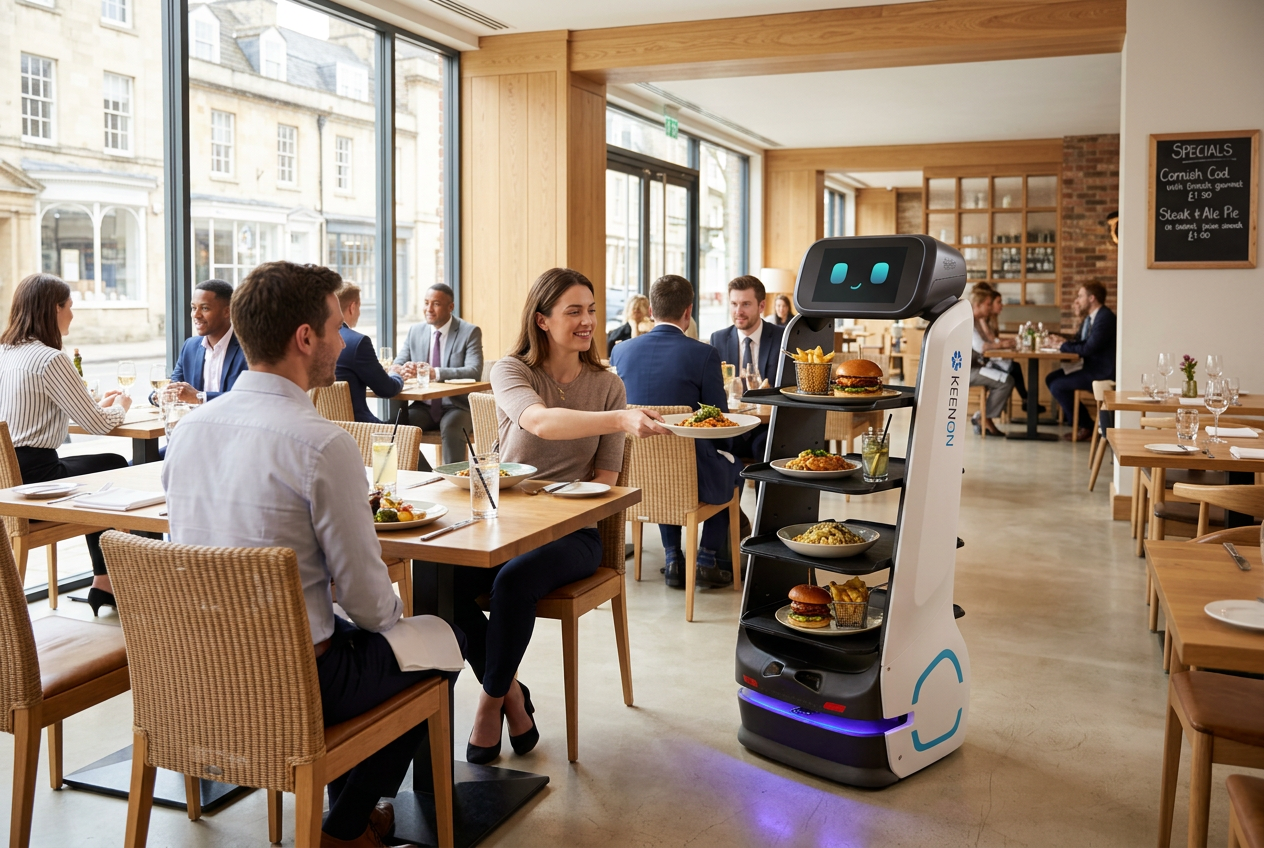
By introducing robots such as the Keenon T6 you remove the mule work. The robot handles the 10-mile round trip between the kitchen and the floor. Your staff stay on the floor, where the customers — and the revenue — are.
Shifting from staffing to optimising
When you integrate automation, your role as a manager shifts. You are no longer just filling holes in a rota — you are optimising a workflow.
1. Reallocating talent to high-value tasks
Instead of having three people running food and one person hosting, you can have one robot running food and four people hosting. High-value in hospitality means guest interaction — noticing when a glass is empty, suggesting a dessert, handling a complex dietary requirement. These are tasks a robot cannot do, but they are exactly what drives your reviews and your bottom line.
2. Predictable capacity
Robots do not call in sick on a Friday night. They do not need a break during a double shift. With a Keenon Dinerbot T5 in your fleet you have a baseline of operational capacity that is 100% predictable. That lets you schedule the human team around peak guest-facing demand, knowing the logistics are covered.
3. Reducing recruitment and onboarding costs
With hospitality turnover among the highest of any UK sector, the cost of constantly hiring and training new staff is a real drain on margins. By using robots to take the strain off the human team you improve working conditions. Happy staff tend to stay longer, and even a modest reduction in churn produces meaningful savings in recruitment fees and training time.
Real-world application — the UK landscape
In hotels, room service is often a logistical bottleneck — staff have to leave the front desk or the floor to take a single club sandwich to the fourth floor. The Keenon W3 Butler solves this by navigating lifts autonomously. The robot takes the delivery; staff stay at the desk to welcome new arrivals. This is not tech for tech's sake — it is a grounded solution to a physical problem.
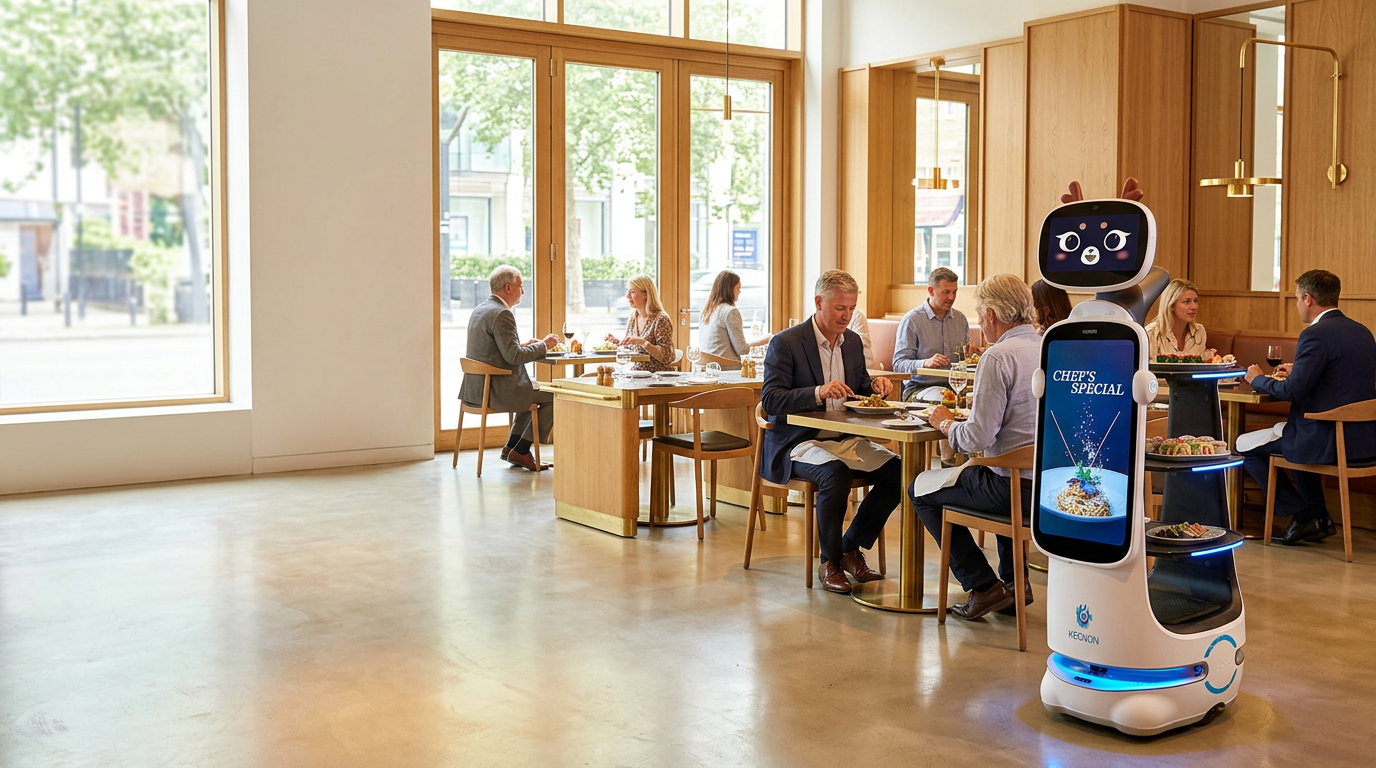
In restaurants, the Keenon Dinerbot T10 does not just deliver food; its vertical screen can act as a mobile advertisement for specials or loyalty programmes. It becomes a tool for both service and marketing, managed by the front-of-house team.
Honest advice on ROI — the 12–18 month window
Based on real-world deployments across the UK, we see a clear ROI within 12 to 18 months. This calculation includes labour cost avoidance (the robot substitutes for low-skill, repetitive manual labour hours), capacity gains (serving more tables during peak hours without adding staff) and reduced attrition (lower recruitment and training costs). If anyone tells you a robot pays for itself in three months, they are not being straight with you.
Beyond food — the cleanliness factor
Managing a team also means managing the premises. Floor cleaning is one of the most monotonous tasks in hospitality. The Keenon C30 autonomous floor scrubber can work through the night or during quiet periods, ensuring your marble lobby or restaurant floor is pristine without a human having to push a mop for four hours.
Practical implementation — no PowerPoint, just results
- Site survey — we come to your premises to see the actual environment.
- Physical demo — we bring a robot to you. No videos, no fluff, just the robot working on your floors.
- Installation & training — we handle the technical setup and train your staff to work with their new robotic colleagues.
- UK-based support — if there is a hitch, our team is right here to fix it.
Conclusion — ask us anything
Hospitality automation robots are changing management because they force us to value human time more highly. When a machine handles the heavy lifting, the human team is free to do what they do best — provide genuine, high-quality hospitality.
Sources
- Vacancies and jobs in the UK — Office for National Statistics (ONS)
- Workforce policy and commentary — UKHospitality
Last reviewed:
Frequently asked questions
Are hospitality robots trying to replace waiters?
No. Robots take over the repetitive running, room service and cleaning tasks that burn staff out, freeing your team for high-value guest interaction.
What ROI window is realistic for a UK hospitality deployment?
A clear ROI window of 12 to 18 months is realistic across restaurants, hotels and care homes when the deployment is properly scoped.
Can a service robot use lifts in a hotel?
Yes — the Keenon W3 Butler is designed to navigate lifts autonomously, which makes it well suited to multi-floor room service.
Talk to a robot supplier you can actually visit
We are based in Ripon, North Yorkshire, with engineers across the North of England. On-site demos as standard.
Related articles
Robotic Food Runner vs. Traditional Waiter: Which Is Better For Your Restaurant?
A head-to-head comparison of robotic food runners and traditional waiters — the honest ROI, the impact on staff morale, and the efficiency numbers that actually matter.
Are Restaurant Robots Worth It? A 2026 ROI Guide
A practical 2026 walk-through of where restaurant robots earn their keep, the venues they suit, and where the payback actually comes from.
Service Robot vs Waiter: Where Does the ROI Come From?
An honest breakdown of where the ROI on a restaurant service robot actually comes from — and why "replacing a waiter" is the wrong framing.
Keep reading