
How to Choose the Best Restaurant Delivery Robot (Compared)
Honest comparison of Keenon T5, T6, T10 and W3 restaurant delivery robots for UK hospitality — specs, ROI guidance and which model actually fits your floor plan.
Quick answer
The Keenon T5 is the best all-round restaurant delivery robot for most UK venues, with four trays and 12–15 hour battery life. The T6 suits narrower dining rooms, the T10 adds branding and 3D obstacle avoidance for busy high-end venues, and the W3 handles cross-floor room service with autonomous lift integration. Most UK operators see ROI inside 12–18 months.

If you are running a restaurant in the UK right now, you know the pressure. Staffing costs are rising, and finding reliable runners who do not call in sick or get burnt out is harder than ever. You have likely seen a robotic food runner gliding through a dining room and wondered if it is a gimmick or a genuine solution for your floor.
At Fresh Mango Robotics, we do not do gimmicks. We do tools. A restaurant delivery robot is a tool designed to take the heavy lifting off your team so they can actually talk to your customers. In this guide, we are stripping away the marketing fluff. We will compare the industry-leading Keenon models — the T5, T6, T10 and W3 — against generic alternatives to help you decide which one actually fits your premises.
The reality of ROI: what to expect
Before we look at the hardware, let us talk about the money. We provide an honest payback period for our clients. In most UK hospitality settings, you are looking at a clear ROI within 12 to 18 months.
A robot does not replace a waiter; it replaces the 10 miles of walking a waiter does every shift. By automating the kitchen-to-table run, your staff stays on the floor, increasing table turnover and upselling drinks. That is where the profit lives.
Key specs: what actually matters on the floor?
When comparing service robots for restaurants, do not get distracted by AI personality or cute faces. Focus on the engineering.
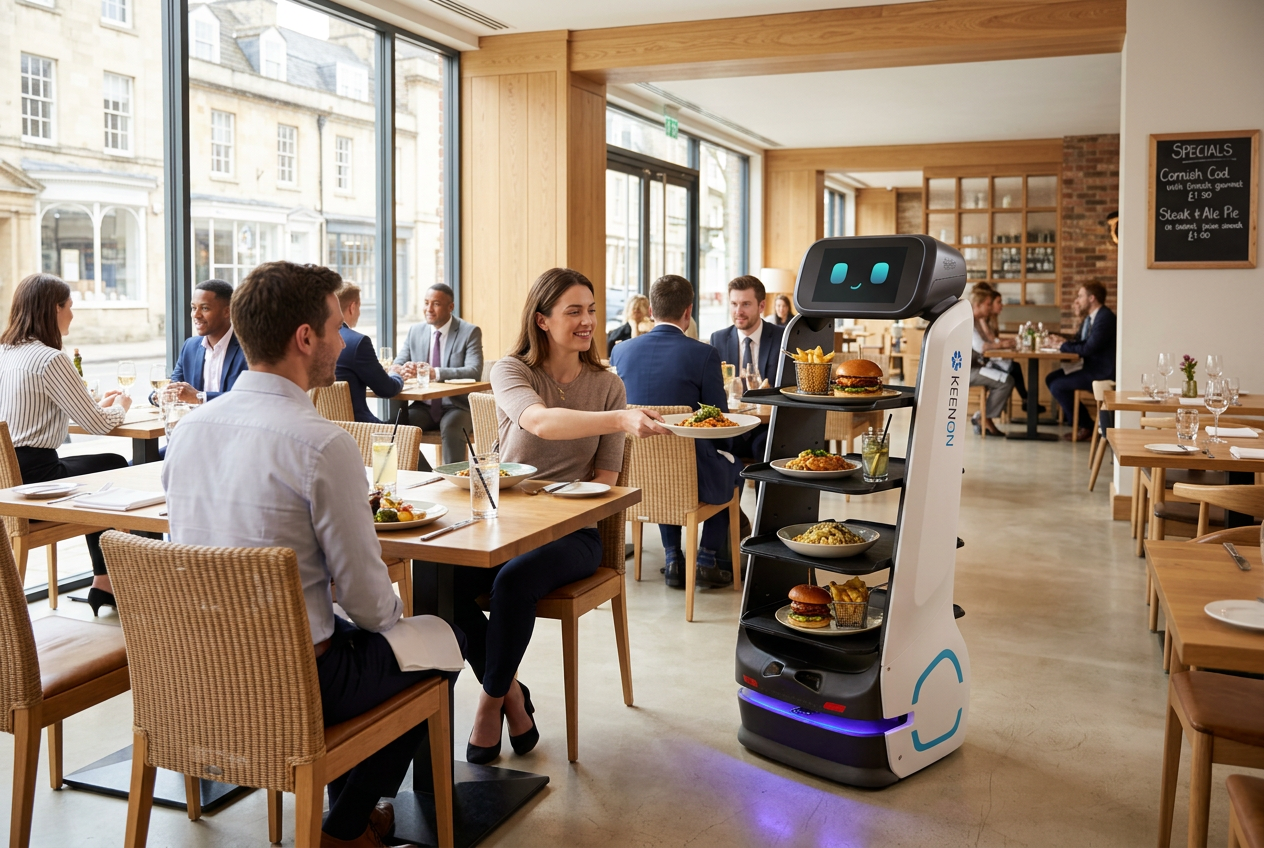
- Payload and tray capacity — How many plates can it carry? A standard runner carries 1–2 trays. A robot like the T5 carries four.
- Battery life — You need a minimum of 10–12 hours to cover a double shift. If it needs charging mid-lunch, it is useless.
- Navigation (SLAM) — Does it use LiDAR or markers? We prefer LiDAR-based SLAM because it does not require sticking stickers on your ceiling. It maps the room like a human would.
- Minimum passage width — UK restaurants are often tight. You need a robot that can navigate gaps of 70 cm to 80 cm without clipping a chair.
The Keenon lineup: side-by-side comparison
We choose Keenon because they are the most stable platforms we have tested. Here is how the models break down for different UK business types.
1. Keenon Dinerbot T5: The Workhorse
The T5 is the entry-point for most restaurants. It is an open-tray system designed for high-frequency deliveries.
- Best for: Standard restaurants, cafes, and pubs with a single-floor layout.
- Capacity: 4 adjustable trays.
- Pros: Extremely reliable, easy for staff to load and unload, and the most cost-effective for pure food running.
- Cons: No enclosed compartments (not ideal for room service).
2. Keenon Dinerbot T6: The Compact Specialist
The T6 is often configured for more specific environments. In our experience, it handles narrower paths better and is often used where hygiene is a priority.
- Best for: Narrower dining rooms or healthcare settings.
- Capacity: Up to 5 delivery tiers (can be enclosed).
- Pros: Smaller footprint than the T10; great for tight turns.
- Cons: Smaller tray surface area than the T5.
3. Keenon Dinerbot T10: The Flagship
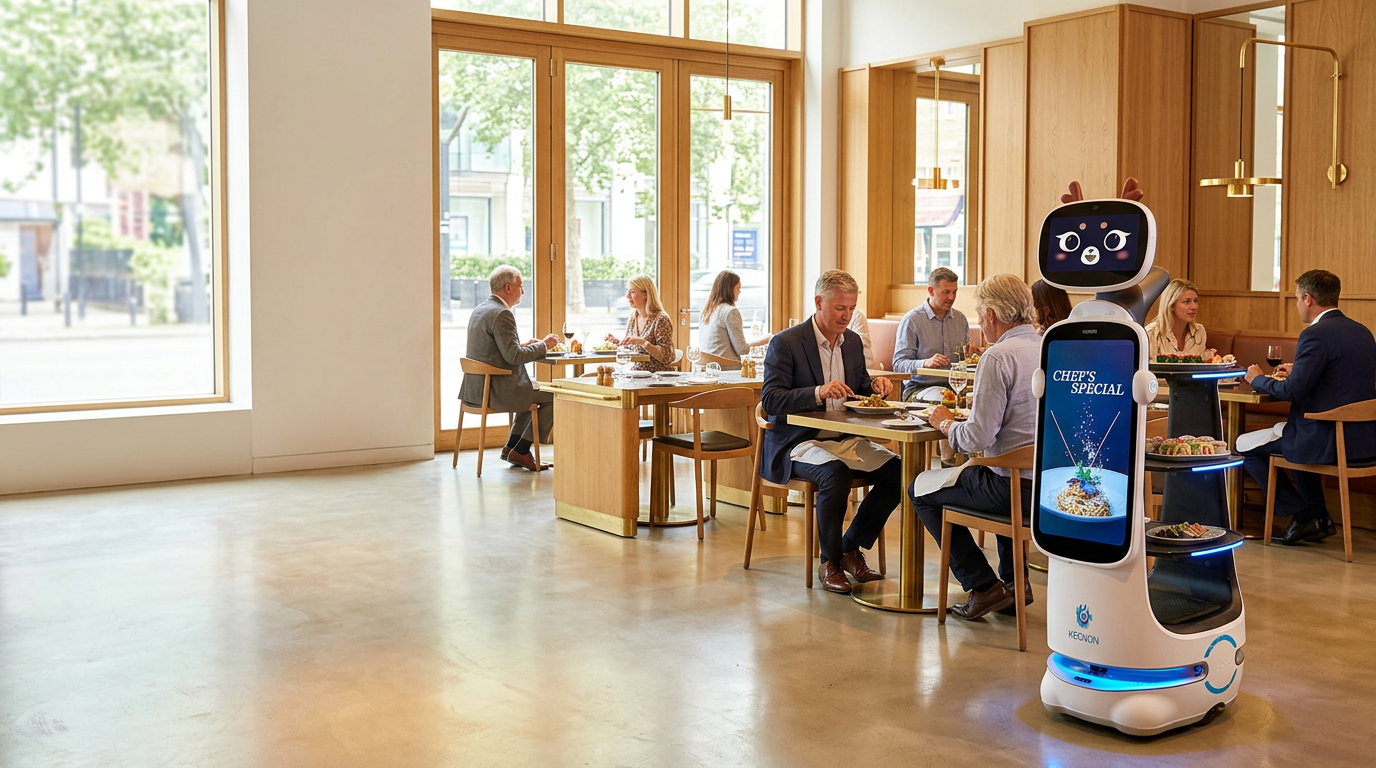
The T10 is for venues where the robot is part of the brand experience. It features a large vertical screen for digital menus or promotions.
- Best for: High-end hospitality, large venues, and event spaces.
- Capacity: 4 trays + 11.6 inch HD display.
- Pros: Advanced 3D obstacle avoidance (the best in class). Excellent for busy, unpredictable environments.
- Cons: Higher initial investment.
4. Keenon ButlerBot W3: The Cross-Floor Expert
The W3 is fundamentally different. It is an enclosed unit that can talk to your lift system.
- Best for: Hotels, care homes, and large office complexes.
- Key feature: Autonomous elevator integration.
- Pros: Food is secure (enclosed and waterproof), can travel between floors, and handles contactless delivery perfectly.
- Cons: Not suitable for table service in a standard restaurant (too slow to unload).
Comparison table: at a glance
| Feature | Dinerbot T5 | Dinerbot T6 | Dinerbot T10 | ButlerBot W3 |
|---|---|---|---|---|
| Primary use | Food running | Narrow paths | Branding / service | Room service |
| Payload | 40 kg (10 kg/tray) | 40 kg total | 40 kg total | 20 kg (enclosed) |
| Battery life | 12–15 hours | 10–12 hours | 12+ hours | 9–12 hours |
| Lift access | No | No | No | Yes (autonomous) |
| Navigation | LiDAR + vision | LiDAR + vision | 3D LiDAR + stereo | LiDAR + stereo |
Generic "off-the-shelf" robots vs. supported systems
You might see generic restaurant delivery robots listed online for lower prices. Here is the honest advice we give every prospect: The hardware is only 50% of the solution.
A generic robot comes in a box. You have to map the floor, set up the Wi-Fi, and hope it does not get stuck under a table. When it breaks — and all machines eventually need maintenance — there is no one to call.
At Fresh Mango Robotics, we do not just sell you a machine. Our process is physical:
- Site survey — We come to your premises. We check your floor types, slope angles, and Wi-Fi dead zones.
- Mapping and installation — Our engineers handle the technical setup. No DIY mapping.
- Staff training — We teach your team how to work with the robot, not against it.
- UK support desk — If there is a glitch, you talk to a UK-based engineer who knows your site.
When NOT to buy a robot
We are pragmatists. A robot runner is not right for everyone.
- Multiple steps or stairs — If your restaurant has small steps between tables and no ramps, a T5 will not work.
- Deep shag carpets — These robots need firm, flat surfaces.
- Extremely low volume — If you only have 5 tables, the ROI will not make sense.
If you are not sure, the best way to find out is to book a demo or a site survey. We will tell you straight if it is a waste of your money.
Conclusion: ask us anything
Choosing the right robotic food runner depends on your floor plan and your covers. Whether you need the high-capacity T5 for a busy pub or the cross-floor W3 for hotel room service, the goal is the same: let the robot do the walking so your people can do the hospitality.
Frequently asked questions
Which Keenon robot is best for a standard UK restaurant?
For most standard UK restaurants, cafes and pubs with a single-floor layout, the Keenon Dinerbot T5 is the best choice. It carries four adjustable trays, runs for 12–15 hours, and is the most cost-effective dedicated food runner in the Keenon range.
How long does the battery last on a restaurant delivery robot?
The Keenon T5 lasts 12–15 hours, the T6 lasts 10–12 hours, the T10 lasts 12+ hours, and the W3 lasts 9–12 hours. For a double shift in a busy UK restaurant, you generally want a minimum of 10–12 hours to avoid mid-service charging.
Can a restaurant delivery robot navigate stairs?
No. Keenon delivery robots cannot navigate stairs or steps. They require firm, flat surfaces and ramps if there are changes in level. The ButlerBot W3 can autonomously operate lifts for multi-floor buildings, but it still cannot handle stairs.
What is the realistic payback period for a restaurant delivery robot in the UK?
In most UK hospitality settings, the payback period is 12 to 18 months. A robotic food runner typically offsets one human runner role, freeing that person for higher-value guest interaction while reducing wage, NI and pension costs.
Talk to a robot supplier you can actually visit
We are based in Ripon, North Yorkshire, with engineers across the North of England. On-site demos as standard.
Related articles
Robotic Food Runner vs. Traditional Waiter: Which Is Better For Your Restaurant?
A head-to-head comparison of robotic food runners and traditional waiters — the honest ROI, the impact on staff morale, and the efficiency numbers that actually matter.
How Much Does a Commercial Service Robot Cost in the UK?
Category pricing bands, monthly rental and total cost of ownership for commercial service, cleaning and logistics robots in the UK.
Service Robot vs Waiter: Where Does the ROI Come From?
An honest breakdown of where the ROI on a restaurant service robot actually comes from — and why "replacing a waiter" is the wrong framing.
Keep reading